5 Steps to Setting Powerful Intentions For The New Year.
Intention setting is the first step in the manifesting process. It is the kick-starting spark and creative power that pushes our desires to be heard by the Universe so the Law of Attraction can work her magic.
A new year is a great opportunity to reflect on your growth of the previous year. It’s a good time to review what you’ve learned and how you’ve grown through the inevitable challenges life presents.
We ask ourselves where we could’ve made better decisions; whether we’re living from our hearts and true intentions. Though it’s easy to forget, we have a tremendous amount of control over our lives. The small decisions we make daily lead to different paths. We don’t have control over what obstacles life throws in our path, but we can control our actions.
Intentions are not goals. Goals put pressure on you and have an external outcome. Intentions align us with our higher purpose.
Focusing on your heart and what’s important to you creates clarity and self-discovery devoting you to finding your dharma. This is where transformation lives.
How to set an intention in 5 simple yin-steps:
Connect with elements of your life that are most significant to you and bring you to the greatest joy, satisfaction and energy.
Make a list of them and share it with a close friend who is supportive and can hold you accountable to take action.
Create a mantra or a short phrase that sums up your deepest call and gives energy to expand your vision. Meditate over these phrases so then your brain will integrate them into actions.
Once you’ve integrated, let it go. Let it go so you don’t attach and grip. The seeds are planted into your awareness. Awareness is a spacious feeling and creates energy for our heart’s desires to flow to you.
Trust that there is a power greater than you to orchestrate the complete fulfilment of your intentions. Do not listen to the voice that says that you have to be in charge.
Do not forget your desires. Live with intention. Walk to the edge. Listen hard. Practice wellness. Play with abandon. Laugh. Choose with no regret. Continue to learn. Appreciate your friends. Do what you love and live as if this is all there is.
May all beings everywhere be blessed with happiness, love, peace and good intention. Yin-Love & Light, Eleonora
Let It Fall Away: 8 Yin Practices To Soften The Heart and Let Go of Your Old Habits.
Winter, by the solstice of December 21st, moves us into the holiday season. It is that time of the year that moves us into high gear with a lot of things happening all in once – people coming and going, gift wrapping, work deadlines, and often times, a lot of stress.
It’s an odd sort of conflict because energetically, the earth wants us to stay quiet – though winter is a time of reflection – but our holidays want us to move around. By moving around I mean the tendency, especially during this time of the year, to move away from our yin-centre where we have learnt to hold a space of self-healing and inner wisdom, to embrace the yang side more, which energetically moves us towards the most peripheral areas of our spiritual life.
But the end of the year is much more than a time of sweetness spent with our siblings, friends and colleagues – it is a sacred time infused with magic and light holding the possibility for bright new beginnings, as we have the chance to let-go of the past in all its forms, experiences, and energies.
Yet, we choose to close the door to the past.
Integrating a Yin-perspective, and mindfulness-based actions, within your holidays will offer you the opportunity to detach from drama and to refrain from mechanisms that will delete immediately any trace of your higher-self.
Instead curve out your own yin-oriented holiday routine for the festive times ahead – secretly holding onto a “yin spaciousness” your way of feeling life, richer in “prana” that can flow in-out the shortest days of the year, has the power to help you create.
Let go of the past by these 8 simple yin-steps we’re summing up here for you:
Refrain from judging – When it comes to not to be judgmental with ourselves and others, it gets really hard – Do encourage yourself positively to let go of mental habits, and beliefs that may be a limit to your own happiness.
Flow with things and people – try and see if you can plan a little less and simply be content with nothingness – having extra time “doing nothing” can be surprisingly healing.
Practice the art of the silence – shifting from talking to being silent, and listening. Experience the yin-magic within saying nothing.
Do not diminish your emotions, especially empower yourself through celebrating all those life experiences that may have led to the feelings of grief, loneliness, anger, depression, etc. Dedicate your thoughts to consider the blessings residing in pain and suffer you may have experienced at times. Look at yourself right now, notice how you have grown in time and space.
Know that life is change, and what you have experienced so far was right there for you to make you step forward in your spiritual path.
Practice extra breathwork and yoga – we can extremely benefit from extra sun salutations and certain pranayama breathing techniques that specifically help us to let go, get grounded and cultivate a clear mind.
Be clear about your intentions, goals and where you are in your life right now – this will also help you feel grounded and cleanse the past.
Forgive. Maybe you made the wrong choices and maybe you even knew it at that time. Maybe the next time you need more information, more guidance, more support, more energy, and more yoga, more of something you did not, this time, have. And going forward, you can do something about that. But first comes to forgiveness.
To successfully move forward, you must end the cycle of self-blame and self-defence and give yourself and others love – this will allow you to create with peace and joy.
Solstice blessings to you.
May us all move through the dark and into the light, bringing our soul’s work into the world with joy and love and light.
Have a lovely yin-winter solstice you all, lighten up your soul.
The motion of yin and yang generates all things in nature.
Yang is known to be more will-oriented, and dynamic in nature. It is eternal motion and cosmic action. Yin on the other hand is receptive, supportive and magnetic. It is eternally stabilizing and of cosmic potentiality. Both yin and yang possess the needed qualities for creation and evolution.
Whenever one is generally overemphasized, the natural harmony is thrown out of balance. This is still the case today in the Western male (yang) dominance of society. This excess of yang on a global level, is a cause of much of the world’s problems today. The same would be true of an excess of yin energy. Both of these forces and their associated qualities must stay in perpetual balance.
The balance of yin and yang provides a filter for how we at Yin Yoga Therapy Training like to look at life.
Never looking at things in black and white. Appreciation for subtleties. Embracing the change and flow. Trying to balance head and heart.
We have a love affair with yin – We believe we need more yin energy in the world, but we know that we only find ourselves through a balance of both yin and yang – we find yin stillness only within yang flow.
Yang morning start, yin afternoon practices, followed by yin and yang evening activities are an integral part of our trainings.
Come and learn a style of yoga that’s focused on bringing balance – physically, mentally and energetically. Yin yoga is the antidote that help to overcome the many issues due to a modern mindset entirely focused on yang instead of bringing yin and yang to a balanced union.
A mantra is a sound (maybe a word, or sentence), that is considered to be able to lead us to liberation. The word mantra comes from the two words: ‘manas’ referring to mind, or consciousness, and ‘tra’ which means ‘to free’. Thus we could say that a mantra can liberate our mind, and merge with universal consciousness.
Traditionally, chanting was used specifically to pass on knowledge from the Vedas. As, at those times, writing was not common, the teachings were transferred in this manner. Usually, students had to be able to remember the text first, before the teacher would comment on them.
You will come across spelling of Sanksrit mantras in different ways. Given that Sanksrit is written in a different script and from there translated and written in modern writing makes that there are different variations. Don’t be upset about the different spelling and follow the chanting of your teacher. Also, be mindful that different schools chant the same mantras differently (different intonation, speed, etc.). Again don’t worry about and rather focus on your intention while you are chanting, that is most important.
Looking at it from a modern approach you can even create your own mantra, it’s the intention which is essential. And the more you practice and repeat, the more powerful your own manta becomes, fine-tuning your body, mind and soul balance.
Benefits
Physical & mental health – chanting is supposed to have many benefits as it creates vibrations that have effect at different parts of the body and mind.
Improved concentration – chanting requires the student to be fully present and listen closely to the teacher. This process of listening and reproducing the chant is called “adhyayanam”. It improves both concentration and memory .
Calming the mind – chanting is a beautiful practice that is both calming and energizing. According to TKV Desikachar (the son of T. Krishnamachary), chanting is an important form of meditation.
Intention: energy flows where attention goes.
Chanting together as a group empathises to bring the individuals together, tuning into the same vibration. Therefore it’s a wonderful thing to do before a yoga class.
The most known mantra: OM – AUM
A – Brahma U– Vishnu M – Shiva
“Om is who is all names and forms” Om is present, past and future Om is the first and underlying sound / vibration of Universe One-ness of all things
It may be the simple desire for connecting with like-minded people, or maybe attaining of inner peace and stillness right inside your busy daily life. Perhaps you’ve been long looking into going on retreat but never made it, committing yourself to a truer lifestyle, deepening your yoga practice–These can be only some of the reasons that made you considering through the idea of tapping into this totally uncomfort-zone of attending a solo retreat.
The noun retreat means “place you can go to” and the verb retreat means “to back out from something”.
We are often influenced daily by your immediate interpersonal connections—family, friends and peers. These familiar outside influences can inhibit our authentic self by conditioning us to see things through their lenses, instead of our own.
A retreat is a wonderful sanctuary of love and peace to be still, and to replenish your soul.
This is your time and you can focus on taking care of your own needs, rejuvenate, and reinvigorate your mind, body and soul.
A retreat will give you some much needed time out to really relax, and forget all of the demands and pressures in your life right now.
It’s vital you give yourself this time and space often, so that you can recharge.
Embarking on a solo journey of any type can be empowering, insightful, and extrememly life-affirming.
Attending a retreat alone will challenge your comfort zone in a way that inspires confidence and encourages growth. When you attend alone, you might tap into your area of vulnerability.
Feeling resistant to attending any type of event alone is what you may be facing at the beginning of your solo journey.
Shift your perspective—this is your time to explore your emotions and to be open to anything that may arise.
It is not within the bounds of what you usually do. However facing all of those emotions provides an opportunity for substantial spiritual growth.
Especially if you are venturing out on your first solo mission having a safe, informative, guided, and serene space is very important to feel free to explore, and to re connect with your true inner voice.
You have this mind, but you’re not this mind.
If you’re always thinking of the next thing you need to do then a yoga retreat gives you a great opportunity to stop overthinking it all.
Turning off all the noise of your own voice, opening yourself to a more positive way of being. Meditating alongside the yoga practice is a tool to use daily to develop mindfulness and to watch what’s behind your mind helping you to harness your thoughts.
Discovering new perspectives.
Whether it is about you own life or through learning about a new culture, embarking in a solo retreat can immediately give you some new perspectives.
We live in a hyper-connected planet, but we tend to misunderstand the meaning of learning. Learning from others can affect your future choices and make you see your own circumstances in a different light.
Giving yourself the chance to growing, connecting, tuning in.
Surf & Soul Retreat in Goa – 13. to 20.October 2019
Here i introduce my favourite sequence to the Daoist Water Element, working with the kidney and urinary bladder meridians. I skip all the technical details but let you know my approach to the poses. For guidance of how to get into and out of poses www.yinyoga.com is always a good resource.
Toe Squat
Toe Squat – Yin Yoga Teacher Training
The Toe Squat is quite a challenging pose to start with, but a beautiful way to activate all our lower body meridians flowing through our feet (UB, GB, ST, LV, SP, K). The pose also provides the opportunity to automatically acupressure K1, our most grounding point under the ball of the foot (releasing excess energy, calms the heart and clears the mind). There is this old Daoist saying “A person with open toes has an open mind’ 😉
Take the help of your hands to make sure all the toes are really stretched out. While guiding my students into the pose I always make sure to mention that if the pressure on the toes is too much you can release the upper body forward and bring your weight on your elbows. If that is still too much (some people are really sensitive here) an alternative is to just bring your toes up a wall, so ball of the foot is on the ground and toes stretch up the wall.
After two minutes swing your feet around to the front and come back for a few moments into a neutral rebound on the back to make sure the toes get some time to release and to let all the lower body meridians flow undisturbed again. Enjoy the happy life sparkles in your toes!
Dragonfly
The Dragonfly pose with a leg/ groin stretch and a forward fold is a very efficient way to stretch our kidney meridian along the inside legs and the groin, while then this meridian gets compressed through the forward fold in our abdomen. Here it crosses our Dan Tien, our energetic and physical body center. It is said here is the place of our instincts. (Additionally our liver meridian get activated in every groin stretch as well.)
At the same time we stretch our urinary bladder meridian all the way out from the backside legs and along our spine flexion, from there it flows along our neck, across our head to the inside corner of our eyes. It flows through our third eye, the place of our intuition, and through our limbic system, which is needed to feel emotionally stable.
The Dragonfly makes a perfect pose to address the energetic value of the water element, to reconnect to our basic trust in life, to trust our journey and to let go of subconscious fear.
Precautions need to be taken for people with lower back issues, hinge from the hips to the maximum point possible first rather than round the spine right away, sitting on a bolster can help. People with tight hamstrings might struggle, then we can place a bolter under the knees. Also it’s important to make sure the feet are not falling inwards, as this is a tendency we don’t want to emphasize regarding our general body posture. Place bolsters on the inside legs to prevent this inward hip rotation.
Three to five minutes, depending if you add some variations, is a good length of time here.
Lateral Dragonfly
Lateral Dragonfly – Yin Yoga Teacher Training
The lateral opening version of the Dragonfly gives us the opportunity to stretch out our gallbladder meridian along the side of our rips as well and the arm stretch is a nice opening for the heart meridian emerging from our armpit. Three minutes on each side is nice.
Dragonfly Twist
Dragonfly – Yin Yoga Teacher Training
Another variation is a simple turn over to the side and forward fold over one leg, addressing the wood element with liver meridian flow through our groin and (like all twists) engaging the liver and gallbladder meridian flow on the sides of our torso. It is nice here to follow the general yoga rule to always exhale as we move into the twist. And like the lateral version here we have the chance to stretch out all our arm meridians of the fire and metal element. Each side for three to five minutes.
After the dragonfly-flow stay in a brief neutral rebound lying on your back before we move deeper into the forward flexion.
Snail
Snail – Yin Yoga Teacher Training
The snail is the biggest release of the whole spine and probably our most intense yin pose. The stretch of the bladder meridian along the spine to the maximum while the kidney meridian get an intense compression in our abdomen makes this an ideal water element pose. It has all the great benefits of the inversion: reversing then blood flow from the heart to the head, flushing trough our blood vessels, giving them a detox which can help prevent a heart or brain stroke. The inversions are said to be ‘the fountain of youth’ in yoga.
To get into the pose you start lying down and lift your hips, support with your hands. Allow your back to round (unlike Halasana in which we keep the spine and legs straight) and your feet to drop over your head toward the floor.
This pose puts a pressure on the neck so be careful if you have neck problems. Like all inversions it is not recommended for anyone with high blood pressure, upper body infection, vertigo, glaucoma, or a cold. Women during their menstrual cycle may find it better not to do this pose or maybe not for too long. For everyone else the longer the better to get the most of the inversion benefits. As alternative the Caterpillar serves well. Avoid this pose with lower back disorders which do not allow flexion of the spine. And its definitely not a good pose with a full belly or are pregnant.
I prefer here to not to dictate the time but let everyone decide for themselves while I just mention every passing minute. However, after maximum five minutes release into a neutral rebound for some time.
Happy Baby
Happy Baby – Yin Yoga Teacher Training
The Happy Baby is another nice opportunity to get some self-healing acupressure point in the practice, here we can easily press K1 (our most grounding point, see more at the first pose Toe Squat) on the sole of our foot at the beginning of the pose. The groin stretch is a great kidney meridian (also liver meridian here) activation. The neutrality of the spine makes this pose the ideal buffer between all the spine flexion’s we just did and the spine extensions, which will follow ahead. Finish with a brief neutral rebond position.
Sphinx & Seal
Seal – Yin Yoga Teacher Training
Always a nice combo is to come from a Spinx into the deeper Seal. Here this pose also functions as a counter pose to the snail to extend our thyroid area.
I recommend staying for three minutes in the Sphinx, elbows right under the shoulders here, and then push the arms up straight for two more minutes into the Seal. The position of the hands may be adjusted toward the corners of the mat, but as always, if you feeling is in your target area, the lower back here, you are doing it. See what feels right!
To have a complete rebound it is better to turn around on your back to also release your ankles.
And as with all our backbends we compress the urinary bladder meridian on our back while we stretch our kidney, spleen and stomach meridians in our abdomen. The pressing up in the Seal also presents us the opportunity to stretch out our upper body Fire and Metal Element meridians, especially the lung and heart meridian.
Release the body back to the ground slowly and enjoy a neutral rebound on your front, suspend the complete rebound on your back for now as we move even deeper into the backbend and keep the ankle stretch with our next pose.
Camel
Camel – Yin Yoga Teacher Training
The camel is a rather active and challenging pose but a beautiful heart opener. However due to its yang nature I like to keep this pose rather short.
The kidney meridian gets stretched out on our abdomen and chest, while the urinary bladder meridian gets compressed on our back. If you can reach your ankles you can even press acupressure point K3 on your inside ankle and UB 60 on the outside ankle. (But this also a perfect pose to open our chest and to stretch out especially our lung meridian along the arm. This pose also makes a good stretch for the earth element meridians on our thighs and abdomen.)
After two minutes come into a brief rebound on your back.
Supported Bridge
Backbend – Yin Yoga Teacher Training
Not a classic yin pose, but my favorite back bend and ideal to be practiced keeping the yin yoga principles in mind. If the block is to hard put a blanket over it or just use a bolster instead and literally just hang out for 5 minutes. It is a wonderful pose to really completely release all our back muscles and to surrender completely in the back extension. I find in back bends it takes the longest to really let go of our natural reactivity of our muscles so it helps to really give this pose a long time. Do come out very slowly vertebrae by vertebrae and enjoy a long rebound in neutral position.
Child Pose aka Turtle
Child – Yin Yoga Teacher Training
After all the back extensions the turtle is beautiful way to bring everything together again, to return back home. Perfect for the water element this pose is connecting our forehead, our third eye, our intuition to the ground beneath us, to mother earth. And of course it gives us the benefits of a gentle inversion: reversing the blood flow from the heart to the head, flushing through and strengthening our blood vessels to prevent heart and brain stroke.
Stay for four minutes. When you are teaching here is a nice opportunity to give your students a back stretch and massage. Before proceeding to the rebound pose it might be nice to just sit on the heels for a moment to let the blood flow reverse.
Reclining Twist
Roots – Yin Yoga Teacher Training
It is always beneficial to finish off with a good reclined twist to restore equilibrium and prepare for our final relaxation. Great pose to really let everything drop and let gravity do the work. Three minutes each side.
Shavasan / Starfish
Starfish – Yin Yoga Teacher Training
A Yin variation of Shavasan, the starfish or penacle. To stretch out our arms and legs a bit more allows us create some space under our arms and between our legs where we have most of our glands and lymphs. This way they get some space to expand breathe, which they never have much in our daily life. Also it creates the opportunity to really stretch out all our meridians to let everything in our body flow uncompromised.
Breathing in, I see myself as still water. Breathing out, I reflect things as they are.
“Stillness is the foundation of understanding and insight. Stillness is strength.” Kudos to Thich Nhat Hanh, Zen Master and a true inspiration when it comes to putting mindfulness principles in beautiful poetic words. He has authored over a hundred books, his more recent are ‘Inside the Now’ and ‘No Mud, No Lotus’. And because we are just so smitten by his work here are some of his thoughts to mindfulness and stillness. Share the love!
From ‘Touching Peace: Practicing the Art of Mindful Living’: “Near the mountain, there is a lake with clear, still water reflecting the mountain and the sky with pristine clarity. You can do the same. If you are calm and still enough, you can reflect the mountain, the blue sky, and the moon exactly as they are. You reflect whatever you see exactly as it is, without distorting anything.
Have you ever seen yourself in a mirror that distorts the image? Your face is long, your eyes are huge, and your legs are really short. Don’t be like that mirror. It is better to be like the still water on the mountain lake.
We often do not reflect things clearly, and we suffer because of our wrong perceptions. Suppose you are walking in the twilight and see a snake. You scream and run into the house to get your friends, and all of you run outside with a flashlight. But when you shine your light on the snake, you discover that it isn’t a snake at all, just a piece of rope. This is a distorted perception.
When we see things or listen to other people, we often don’t see clearly or really listen. We see and hear our projections and our prejudices. We are not clear enough, and we have a wrong perception. Even if our friend is giving us a compliment, we may argue with him because we distort what he says.
If we are not calm, if we only listen to our hopes or our anger, we will not be able to receive the truth that is trying to reflect itself on our lake. We need to make our water still if we want to receive reality as it is. If you feel agitated, don’t do or say anything. Just breathe in and out until you are calm enough. Then ask your friend to repeat what he has said. This will avoid a lot of damage. Stillness is the foundation of understanding and insight. Stillness is strength.”
Mindfulness methods can be traced back to the yoga traditions of Hinduism. Buddha refined its practice some 2,600 years ago as part of a spiritual discipline leading to enlightenment, where the mind is free of suffering and in a state of complete wisdom and compassion. Mindfulness is the main element in Vipassana or Insight and Zen meditation practices.
Mindfulness now is most commonly known as a term for a mind-body medicine practice, which was first popularized by Jon Kabat-Zinn. He convinced the western medical establishment that the Buddhist meditation and yoga techniques he practiced were worthy of medical trials. He wanted to establish whether he could help people with chronic pain, by changing the way they felt about their pain. The mindfulness approach was secularized in order to make it accessible for the mainstream, taking out any religious, spiritual or New Age elements. Thus, mindfulness crossed over into western medicine and has been used to help a wide range of physical and mental health conditions.
So it is pretty much the same old story (Dao, Zen, Enlightenment) in a modern interpretation. Probably twenty years ago, a person interested in mindfulness was more likely to find a Buddhist-based offering than a secular mindfulness program. Nowadays, the reverse is true. The fact that this secular approach to mindfulness does not incorporate any cultural or doctrinal elements, spiritual brand or religion makes it easy accessible to everyone.
One of the first and most popular of these secular offerings is Mindfulness-Based Stress Reduction (MBSR). Scientists have found that practicing mindfulness is associated with changes in the structure and function of the brain as well as changes in our body’s response to stress, suggesting that this practice has important impacts on our physical and emotional health.
While most people seem to think that mindfulness is a good thing, many people are confused about what exactly mindfulness is?
One official definition of mindfulness: “Mindfulness is the self-regulation of attention with an attitude of curiosity, openness, and acceptance.”
According to Jon Kabat-Zinns’ teachings, mindfulness is an internal resource that all of us already have within us. The idea is to channel or direct this resource to transform our relationships with stress, emotions, pain, and illness and to deal with our reactivity to our emotional provocations in ways that promotes greater conscious control over our temporary sensations.
“Mindfulness means paying attention in a particular way: on purpose, in the present moment, and non-judgmentally.” Jon Kabat- Zinn
“I don’t think there is any one problem or one solution. It is really more about being open to what your moment by moment experience is, which is the definition of mindfulness. When you look at mindfulness you could really translate mindfulness as transparency. What is happening in your own mind is becoming more transparent to you. ” – Ethan Nichtern
I like to see Mindfulness as the Yin way of meditation. Rather than the classic meditation techniques of concentrating and focusing on one thing forceful in a yang way – trying to control the mind – we just allow what is. We watch it, and watch it change – not identifying ourself with our mind.
In general mindfulness is seen as a non-judgmental awareness in which each thought, feeling, and sensation that arises is acknowledged and accepted as it is. This steady and non-reactive attention is often radically different from the way we normally operate in the world.
There are three key characteristics of mindfulness:
Intention to cultivate awareness (and return to it again and again)
Attention to what is occurring in the present moment (simply observing thoughts, feelings, sensations as they arise)
Attitude that is non-judgmental, accepting, curious, and kind
Simple as it may sound, mindfulness transforms how we relate to events and experiences. It creates a more spacious way of being in the world that is less reactive and generally happier.
Mindfulness is different from our default mode. Developing a steady and non-reactive attention is often radically different from the way we are in the world. Many of us spend large parts of our lives on auto pilot, not aware of what we are experiencing, missing out on all the sights and sounds and smells and connections and joys we could appreciate. Some of that time our minds seem “switched off,” and other times caught in thoughts from the past (often regrets) or plans for the future, much of which is repetitive. When we do notice something in the present, our habit is often to judge instantly and react quickly, often working from a faulty or limited perspective that restricts our options or creates issues. Mindfulness helps us be present in our lives and gives us some control over our reactions and repetitive thought patterns. It helps us pause, get a clearer picture of a situation, and respond more skillfully.
Compare your default mode with a mindful state.
Consider how you react when you don’t think you are good at something: say solving brain teasers. When you are presented with a brain teaser, what do you do? Do you tell yourself, “I am not good at this,” or “I am going to look stupid”? Does this distract you from paying attention to working on the puzzle?
How it might be different if you had an open attitude with no concern or judgment about performance, just a curiosity about how working on the brain teaser might be? What if you directly experienced the process as it unfolded—the challenges, anxieties, insights, accomplishments—acknowledging each thought or feeling and accepting it without needing to figure it out or explore it further.
If you do this with some regularity, you start to see the habitual patterns that lead you to react automatically in negative or unhelpful ways and create stress. By observing instead of reacting, you develop a broader perspective and can choose a more effective response.
The practice of mindfulness helps to strengthen the mind so that we experience increasing presence in our lives. Instead of abandoning ourselves when we encounter difficulty, we are fully awake. Mindfulness also strengthens and re-programs the nervous system so that we experience a lesser degree of struggle during physical, mental, or emotional challenge. We train the mind to reduce resistance and contraction when events don’t go according to our plan.
Mindfulness is the practice of directing your mind by cultivating the power of your attention. In other words, we are working and strengthening the muscle of awareness through sustaining a focus. Through this training of mindfulness we actually condition the mind to be more mindful.
In the west we think of “medicine” as a way of dealing with illness and disease. In contrast, Oriental medicine focuses on achieving health and wellbeing through the cultivation of harmony within our lives. Yin yoga is one way to do so.
And as yin yoga works with the acupuncture meridians you are surely familiar with the common used term ‘Chinese medicine’. But we like to emphasize a bit broader thinking. Here is some background info:
Traditional Chinese Medicine (TCM) is the official form of Chinese medicine practiced in the People’s Republic of China, and is ONE of the MANY systems of medicine that can be classified as “Oriental Medicine” and which works with the meridians.
Oriental Medicine is a term that encompasses diverse medical theories and applications developed and practiced in the East, including China, Korea, Japan, Taiwan, and Vietnam. It is believed that Oriental medicine origins go back way more than five thousand years.
TCM as it is known now was invented and structured in the 1950s during a period of nationalism in the Republic of China, marked by idealism and pride of China’s ancient heritage and rejection all of western influence. It is probably the most frequently encountered and most familiar of the Asian medical systems as it has an extensive body of literature and research supporting it.
All Oriental Medicines are based on the concept of “chi” and the theory of “yin and yang”. In essence they believe that:
Harmony brings health, wellbeing, and sustainability.
Disharmony leads to illness, disease, and collapse.
They provide guidelines on how to best facilitate harmony between yin and yang in any given circumstances and how to create and circulate an abundance of chi to sustain health and wellbeing.
In our Yin Yoga Therapy Trainings we utilize the theory of these concepts based on Oriental medicine and Daoism much more than just TCM. The Yin Yoga Healing Method is a holistic approach to balance, health and harmony in life.
Because making healthy choices is a form of self-respect!
“The moment you get up on that surf board there is that feeling of complete oneness with the ocean. Its like you’re both breathing together at one time”
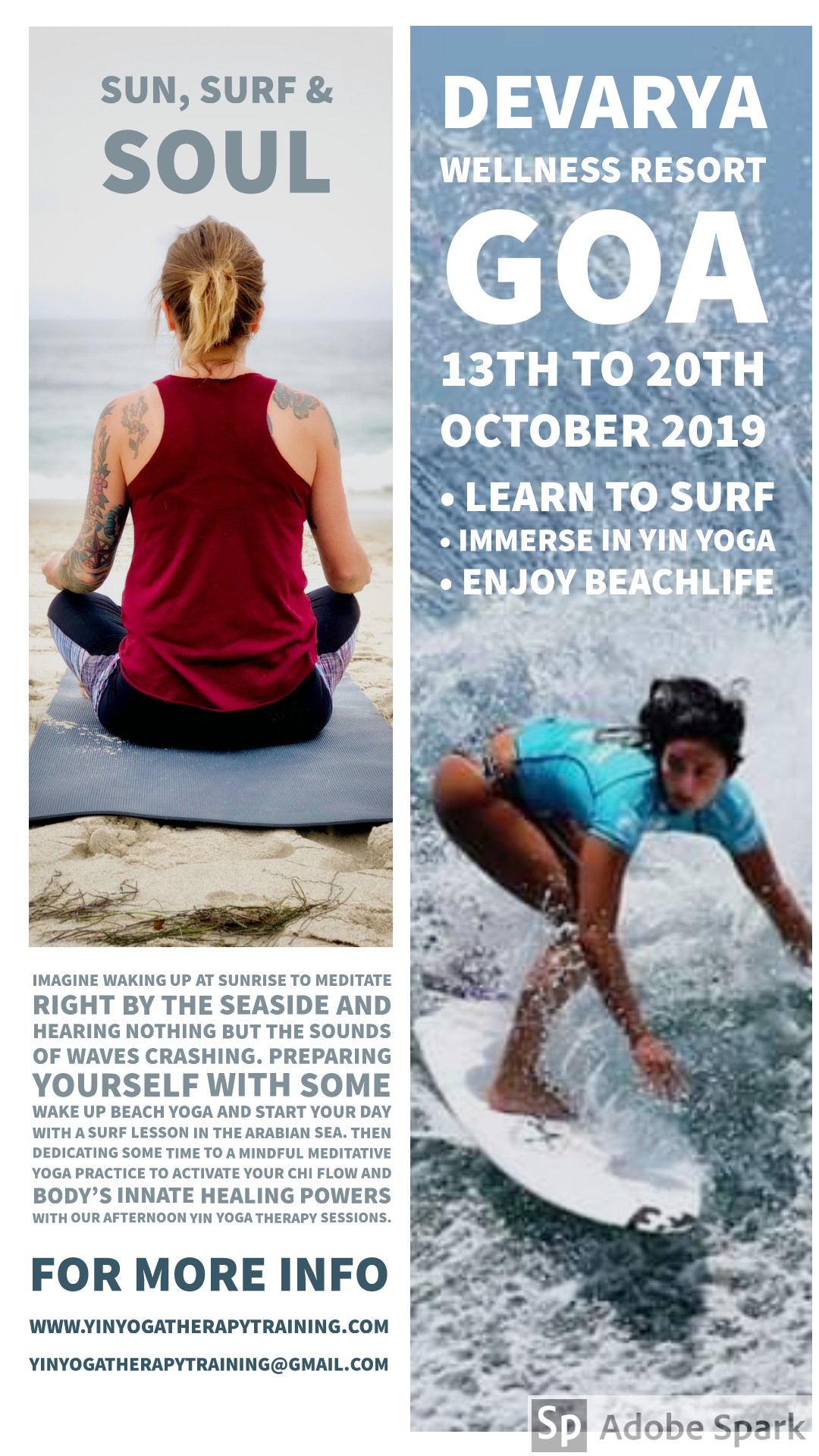
Imagine waking up at sunrise to meditate right by the seaside and hearing nothing but the sounds of waves crashing. Preparing yourself with some wake up beach yoga and start your day with a surf lesson in the Arabian Sea. Goa with its rather soft waves is the perfect location to learn surfing!
After an active start in the day you will enjoy a sublime brunch buffet and find some time and space just for yourself. Time out for just being, enjoying the relaxation of life by the beach.
In the late afternoons immerse in Yin Yoga Healing sessions, dedicating some time to a mindful meditative yoga practice to activate your chi flow and body’s innate healing powers.
If you have a love for adventure and a deep respect for life and nature combined with an uncompromised sense of integrity for your personal evolution this retreat is for you!
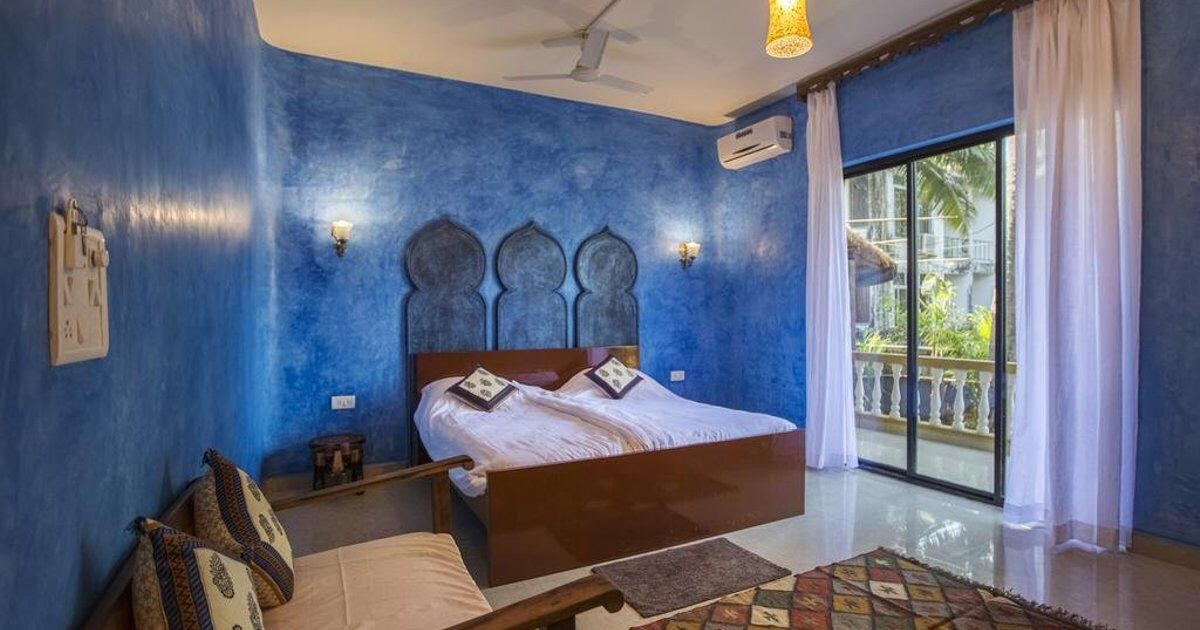
Join us for this unforgettable “Surf & Soul” experience filled with yoga, surf and self development – just exactly how we like it. Learn to surf, restore with yin yoga, pamper yourself with our luxurious stay at Devarya Wellness Retreat and spend your days enjoying the beach in the shade of a coconut tree.
In yoga and surfing we play our sensations, each time awaiting a new invitation. We ride the edges of our poses with a gentle flowing breath, like a surfer is riding the waves of the ocean. Yoga and surfing is just such a fantastic combination in so many ways. Surfing is active and dynamic. There is quite a difference to yoga’s mindful movements and meditation practices. But then, there are a lot of similarities. Going with the flow, tuning in and listening to your body closely as we are being connected to the ocean. It’s the feeling of complete oneness, which requires us to be in tune with nature and our body.
Surfing is a “YANG” form of exercise, full of movement, rhythm and repetition. Through this movement our muscles expand and contract, growing stronger. But by this we are also limiting our bodies, we tend to lose our natural softness, becoming more inflexible and increasingly tight. With all the paddling and repetitive take offs on a fun surf morning, we need the “YIN” in order to keep the flexibility and longevity in our bodies.
So … if surfing is your “YANG”, let yoga be your “YIN”. The combination of Surfing with Yin Yoga gives us the balance our bodies need to experience optimum health and happiness.
One-way to think of balance is this: a total state of health that incorporates togetherness of body and mind. To be balanced is a way of being and a state of mind. Yin Yoga can restore this balance and be the soothing balm to heal and rejuvenate body, mind and soul. Let us take you in the afternoons on an inner Yin Yoga Healing journey through the Taoist elements and learn about their energetic value and the chi meridian flow in your body.When you awaken and align your body’s underlying energy, you activate your innate process of healing and transformation. Yin Yoga will help you create profound shifts in your physical and emotional well-being. We will demystify how energy affects everything you do and feel and show you how to mindful work with your body and mind. These Yin Yoga Healing sessions will help you build vitality, unravel energetic blockages, and boost your immunity.
With our Surf & Soul program you have the opportunity and space to let your mind learn from the body experience of learning new things and cultivate a free spirit. To love life and live free.To be in touch with nature and yourself. And then, we might realize, there is nothing more grounding than a body and a mind that have decided to be whole.
By the end of this retreat, you will feel stronger, healthier, and better able to thrive and flow in the life you are meant to live!