Posted on

Sri Lanka Easter Attacks Update

It’s some time since the tragic attacks in Sri Lanka and in preparation for our upcoming training we feel positive now to continue with our plans. Now is exactly the time to show up and show our support.

To give our guests a bit more insight of the situation we share here the words of a fellow yogini, living on the island right now:

Thank you Emma for your wise words.

Our hearts continue to hurt for the beautiful island and her people. Sending out love.

Posted on

Love and Compassion

We just had to share these beautiful notes from the Dalai Lama about what brings us happiness:

“I believe that the purpose of life is to be happy. From the moment of birth, every human being wants happiness and does not want suffering. Neither social conditioning nor education nor ideology affect this. From the very core of our being, we simply desire contentment. I don’t know whether the universe, with its countless galaxies, stars and planets, has a deeper meaning or not, but at the very least, it is clear that we humans who live on this earth face the task of making a happy life for ourselves. Therefore, it is important to discover what will bring about the greatest degree of happiness.

From my own limited experience I have found that the greatest degree of inner tranquility comes from the development of love and compassion.

Ultimately, the reason why love and compassion bring the greatest happiness is simply that our nature cherishes them above all else. The need for love lies at the very foundation of human existence. It results from the profound interdependence we all share with one another. However capable and skillful an individual may be, left alone, he or she will not survive. However vigorous and independent one may feel during the most prosperous periods of life, when one is sick or very young or very old, one must depend on the support of others.

Because we all share an identical need for love, it is possible to feel that anybody we meet, in whatever circumstances, is a brother or sister. No matter how new the face or how different the dress and behavior, there is no significant division between us and other people. It is foolish to dwell on external differences, because our basic natures are the same.

Ultimately, humanity is one and this small planet is our only home, If we are to protect this home of ours, each of us needs to experience a vivid sense of universal altruism. It is only this feeling that can remove the self-centered motives that cause people to deceive and misuse one another.

Whether people are beautiful and friendly or unattractive and disruptive, ultimately they are human beings, just like oneself. Like oneself, they want happiness and do not want suffering. Furthermore, their right to overcome suffering and be happy is equal to one’s own. Now, when you recognize that all beings are equal in both their desire for happiness and their right to obtain it, you automatically feel empathy and closeness for them. Through accustoming your mind to this sense of universal altruism, you develop a feeling of responsibility for others: the wish to help them actively overcome their problems. Nor is this wish selective; it applies equally to all. As long as they are human beings experiencing pleasure and pain just as you do, there is no logical basis to discriminate between them or to alter your concern for them if they behave negatively.

Let me emphasize that it is within your power, given patience and time, to develop this kind of compassion. Of course, our self-centeredness, our distinctive attachment to the feeling of an independent, self-existent identity, works fundamentally to inhibit our compassion. Indeed, true compassion can be experienced only when this type of self- grasping is eliminated. But this does not mean that we cannot start and make progress now.”

Posted on

A real life report on mindfulness

Here we introduce Argos Gonzalez, a real life mindfulness hero to you.

As a high school teacher in the Bronx for 14 years I got to meet and deeply know a lot of teens. Having those relationships taught me a lot about what makes adolescents tick. I saw that the way adults view teens impacts the way teens see themselves, and ultimately the lives they think they are capable of leading. I also witnessed how school settings can be fertile ground for greater understanding and connection, or misunderstanding and miscommunication between teachers and young adults.

One of the high schools I worked at was a traditional school, with honors classes, Advanced Placement courses, Senior trips and proms. The other was a transfer school, where students go as a last chance for a high school degree (their prior schools failing to meet these students’ needs in one way or another). In this school students call teachers by their first name, they work closely with community based organizations, and it’s where I was lucky enough to introduce mindfulness.

Both schools were Title 1 schools, which meant the majority of the students were receiving free or reduced lunch. Both had committed, caring (and overworked) administrators, staff and teachers.

Since leaving the classroom I’ve gotten the opportunity to work with teens in more affluent communities (one of the schools a mere 10 miles north of the transfer school) where kids are getting the best education and resources their parents and communities can generously give. I wasn’t surprised to also see committed, caring, and overworked administrators, staff, and teachers but I was surprised to see how much these teens were also struggling.

Even though these adolescents’ educational contexts are very different, a couple of things are true for all of them. The adolescent years are challenging, confusing, and filled with changes to the body, their brain, and relationships. Adolescence is a tumultuous time of our lives!

Let’s also not forget about technology and the impact it’s having on our children. Most of us can probably remember what it was like to be bored when we were young and not have a screen readily available. Our parents would tell us to figure it out, go outside, go play. Or they would assign us a chore to make sure we didn’t stay bored. These moments of boredom often led to free play, which is critical in child development. According to the American Academy of Pediatrics free play helps children develop their imagination, curiosity, and healthy relationships with the children around them and their parents.

Whether we think the advent of technology is good or bad, it is here to stay and it is rewiring our children’s minds. Many have a harder time focusing their attention and developing relationships outside of their digital persona.

The developing brains of adolescents

When I taught mindfulness to my teens in the Bronx, I often introduced the book Brainstorm by Dr. Daniel Siegel. Even though it was a challenging text for them to get through, they were engaged with the book because it was giving them insight into the way adults looked at them. It helped them understand what was changing in their brains and effecting the way they were feeling and acting. I will summarize some of the things I shared with my students here, but if this is a topic, you think would be helpful to you or your students will find interesting, make sure to add Brainstorm to your reading list.

Myths of adolescence

The way we see adolescents becomes the way they see themselves. These misunderstandings can lead to confusion and conflict for teens and adults. Which of these myths are you familiar with?

  1. Raging hormones cause teenagers to “go mad” or “lose their minds.”
    According to Siegel hormones do increase, but these levels then stay consistent throughout much of adulthood. Its not the hormones that are causing behavior changes. What adolescents experience is primarily the result of natural and needed changes in their developing brains.
  2. Teens are immature and need to grow up.
    The risk-taking tendencies, impulsiveness, and high emotional sensitivity of teens is not a sign of immaturity but rather an outcome of exactly what they are supposed to be doing during this developmental stage—testing boundaries, creating their own view of the world, and preparing for life beyond the family home and school community.
  3. Growing up requires moving from dependence on adults to total independence from them.
    The healthy move to adulthood is toward interdependence, not complete do-it-yourself isolation. Giving care and receiving help from others is the model we should be supporting.

Pause, take a couple of breaths, and reflect on your own middle or high school experience. I’m sure you can understand why adolescents struggle during this time of their lives especially if the adults around them fundamentally misunderstand them. Remembering our own experience can help us be more understanding and compassionate in the interactions we have with teens.

Qualities of the adolescent mind

Dr. Siegel goes on to name the attributes of the adolescent mind as well as the benefits and challenges associated with these changes. His book also guides reader through activities that ask adolescents to reflect and bring awareness to their internal landscape, and which support healthy communication.

Novelty Seeking

Increased drive for rewards and increased inner motivation to seek new experiences and feel life more fully

  • Upside: The drive for social connection leads to creation of supportive relationships that can support and enrich teens their whole life
  • Downside: Adolescents might isolate themselves from other adults and only surround themselves with other teens, which can lead to increased risky behavior
Increased Emotional Intensity

Emotional sensitivity increases, allowing teens to feel life experiences more intensely

  • Upside: Emotional intensity can fill teens with energy and a sense of vitality for being alive
  • Downside: Emotional intensity can fill teens with energy and a sense of vitality for being alive. Emotions can rule the day, leading to moodiness and, sometimes unhelpful, reactivity
Creative Exploration

Expanded sense of being leads to conceptual thinking that question status quo and approaches problems with out-of-the-box solutions

  • Upside: Sense of wonder, creativity, and curiosity can be nurtured; new solutions and strategies for a fuller life are explored
  • Downside: New explorations can lead to crisis of identity, susceptibility to peer pressure, and lack of direction or purpose

Taking these findings into account highlights why mindfulness interventions are critical at this age.

There is promising, if nascent evidence, that mindfulness can support adolescent well-being by supporting development of their prefrontal cortex (where empathy, thinking of consequences, and other executive function skills live), by enhancing their ability to focus, and helping them name and regulate their emotions. In addition, studies of adults participating in mindfulness interventions like Mindfulness Based Stressed Reduction “suggest that participation in MBSR is associated with changes in gray matter concentration in brain regions involved in learning and memory processes, emotion regulation, self-referential processing, and perspective taking.” These research studies, coupled with my experience teaching adolescent, makes it easy to argue for introducing mindfulness interventions to adolescents.

Introducing mindfulness to teens can be especially rewarding and challenging. Working with adolescents can bring to the surface the unresolved feelings and painful experiences we faced as adolescent. To be effective with this age group, we must reflect and turn to our own practice. We also have to make sure that when we offer mindfulness to adolescents it is relevant and engaging otherwise we won’t be able to truly support them.

Working with teens

Some of these apply to all age groups, but they hold special importance when working with adolescents. Adolescence spans from the ages of 12 to 24. This is one of the most confusing times of our lives, even when things are going well.

  • Remember what your adolescence was like, and have compassion!
  • Students’ feelings should be validated always, but especially keep this in mind now, because many adults are dismissive of the strong emotions of teens.
  • Practices, conversations, and activities should be relevant to the students’ lives.
  • Learning should be student centered when possible, and students should be given opportunities to share and interact with one another.
  • Students tend to be sensitive about the way they are perceived by others, but they might not fully understand how they perceive themselves.
  • Support healthy identity formation by creating a culture of acceptance of individual difference and respect for personal boundaries.
  • Avoid stereotypical language, and recognize your own assumptions and biases.

Learn more on Argos Gonzalez.

Argos Gonzalez is a teacher, lecturer, and mindfulness and yoga instructor. He has 14 years of experience teaching high school in the Bronx and teaches pre-service and in-service teachers at Hunter College School of Education in NY. Argos is certified through both Mindful Schools and Little Flower Yoga (LFY), and currently serves as the director of professional development for The School Yoga Project, a program of LFY and Lead Teacher for Mindful School’s Mindful Teacher yearlong certification program.

Posted on

Energy Flows Where Attention Goes

sunprayer - yin yoga teacher training

It is always interesting to me to see the differences between successful people who appear to be abundant, fortunate, and prosperous and those who seem tired, exhausted, and struggle to make ends meet. Successful people know that it’s important to set specific goals, consistently review them, focus on their skills, and act on opportunities to achieve their goals. They don’t journey through life reacting to every situation, they steer their course through life and expect good outcomes in spite of what is going on around them.

We all want to be consistent in focusing on our goals, but that can be tough when life presents us with unexpected situations. Your boss might ask more of you at work; your children or spouse might need you to be home more often and available to attend important events; you might even feel like you don’t have enough time for yourself to relax, have fun, and plan for the future. Before long, consistency can seem like an unobtainable dream.

Often in the midst of crisis, competitive pressures, and family obligations, we can feel overwhelmed and forget to focus our attention on the desired outcomes of our goals rather than the immediate circumstances of our situations. We can listen to the news, read industry reports, and hear colleagues who describe probable and dismal outcomes that they say are inevitable. The only way to keep yourself focused on the goals and outcomes that you want to experience is to follow a consistent daily routine that is deliberate in priming your brain for success so that you can achieve the outcomes that you desire.

In my personal practice I’ve learned that the most effective way to keep your goals in the forefront of your thoughts is to wake up 30 minutes earlier each morning to hold a meeting with your inner self.

Treat your morning meeting with your inner self seriously. Hold your meeting in a space that is free of disruptions, and create an agenda that you’ll follow. Make sure that you also have the necessary tools available: an uplifting book that describes successes of others achieving their goals, a pen, and a notebook for you to write in.

Read something that inspires you

Spend five minutes reading something uplifting to put you in a receptive mood. As you read about the successes of others, your mind will look for ways to make those kinds of successes familiar and normal for you. Suggested books to read are listed in the back of my book, The Path to Wealth.

Write down what you are grateful for

Spend up to 10 minutes writing a gratitude letter. Be grateful for the good things already in your life, as well as the things that you hope to have soon. Psychologists agree that gratitude and happiness help you to be more focused and able to solve problems.

Express gratitude for what you have like health, family, and great employment. Also express gratitude for what you want as though you already have received it; harmonious relationships with family, friends, customers and co-workers and increased sales at work. The subconscious will then be directed to search for ways to help make these goals a reality.

Read what you are grateful for out loud

Spend up to five minutes reading your letter out loud with emotion. Studies have shown that when we read something out loud, we anchor it into our subconscious, which will help us to notice more possibilities to make our statements true. Remember the last time that you were planning to buy a new car? Didn’t you start to see that car on the road everywhere just before you purchased it? Your subconscious was helping you to notice possibilities to make that car yours.

Visualize reaching your goals

Spend up to five minutes with your eyes closed imagining what it will be like to have your goals realized. What will you be experiencing, and how will you feel? Who will be celebrating with you? As you see yourself in your realized goal, you’ll anchor the belief that it can be yours.

Olympic athletes use this technique as part of their training. They see themselves making the shot, winning the competition, celebrating with teammates and family. If you want to win and achieve your goals, see yourself doing so first. Jack Nicklaus, one of the world’s greatest golfers never took a shot, not even in practice, without having a clear in-focus picture of it in his mind first. Author and motivational speaker, Earl Nightingale put it perfectly when he said “Whatever we plant in our subconscious mind and nourish with repetition and emotion will one day become a reality.” He knew that repetition would reap rewards.

At this point, you’ve spent 25 to 30 minutes with your inner self establishing your goals and giving your subconscious directions on what to focus on attaining. Now, go ahead and get your day started. Your subconscious will begin to do its job.

Follow your intuition throughout the day

During each day, be on the lookout for leads, intuition, directions, and opportunities that will point you in the direction of goal attainment. Some of these leads might not make sense, but as Steve Jobs said, “have the courage to follow your heart and intuition.”

Take a step to do something, call someone who comes to mind out of the blue, or follow up on a gut instinct to go to a particular location. I once followed a gut instinct to drive 15 minutes out of my way in Cleveland and ran into a potential customer who later gave me a new contract worth over $400,000. In another example, I had a strong thought about my sister and was led though a series of intuitive directions to have a spot on my leg removed that was later diagnosed as malignant melanoma Clark’s level 3.

Many famous and successful business people have used intuition as a success tool. Bill Gates said, “Often, you have to rely on intuition.” And, Oprah Winfrey shares “I’ve listened to that still small voice of intuition my entire life and the only times that I’ve made mistakes is when I didn’t listen.” All of us have intuition and can learn to recognize it and enable it to show up more often through a daily routine for success.

Celebrate your successes

Acknowledge your successes with someone who you value and trust. Celebrating and happiness activate the frontal cortex of your brain, which helps you to focus clearly and see more possibilities. Celebrating is a fun part of the process and helps you to gather proof and confidence that your partnership with your inner self is working

Let go of what’s holding you back

Give up anything that could be subconsciously holding you back. If you are angry or feel any resentment toward another or yourself, give it forth. This may be one of the greatest characteristics of successful people. They release anything that is not consistent with the life they want to live. This can be tough, but it is possible.

To start, commit to saying the following each night before bed: “I release anyone and anything from my past or present that is not serving me well, whether I remember them or not. And if there is anything that I have done in my past or present that needs to be released, it is now done and everyone is free.” Do this for a minimum of 30 nights, and you’ll feel lighter and more at peace as a result. You’ll also be able to notice more possibilities to help you to attain your goals sooner.

Practice these seven steps on a regular basis, and enjoy realizing your goals in a more consistent and enjoyable way. May you be blessed on Your Path to all that is Good!

This article appeared on https://artoflivingretreatcenter.org and is reposted with permission from the author. A wonderful reminder from May McCarthy on how to manifest our dreams into reality on our path to all that is good.

Posted on

Take a look at Iyengars Yin Variations

Take a look at Iyengars Yin Variations

Here we share an article from our friends of the Art of Living Center by Senior Iyengar Teacher Marla Apt. Interesting how if you would skip the first two poses the Iyengar sequence becomes very yin like. Get yinspired and try these Iyengar props in 5 minutes holds.

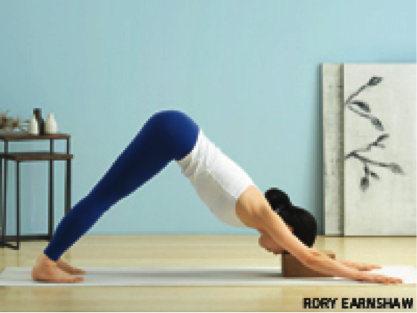
1. Adho Mukha Svanasana (Downward-Facing Dog Pose), supported

With your hands and knees on the floor, place a block under your chest. Straighten your legs and lift the pelvis up. Push the floor away to extend and lift the torso. Keeping your arms straight, release your neck and rest your head on the block. Adjust the height of the block or add a blanket to rest the head easily. Keep the arms and legs strong and the face soft. Hold for 2 minutes.

Adho Mukha Svanasana (Downward-Facing Dog Pose)

2. Adho Mukha Vrksasana (Handstand)

Adho Mukha Vrksasana (Handstand)Place your hands a few inches away from a wall. From Adho Mukha Svanasana, walk the feet closer to the wall, lifting the hips. Raise one leg straight up toward the ceiling, and push off the other bent leg to kick up and take the feet to the wall into Handstand. Keep both arms straight and stretch the heels up the wall. Spread the palms and extend from the arms through the sides of the chest up to the feet. Lift your head slightly to look at the wall. Hold for up to 1 minute. If you can’t get into Handstand, try kicking up several times, working on taking the pelvis toward the wall as you kick up; then repeat Adho Mukha Svanasana.

Adho Mukha Vrksasana (Handstand)

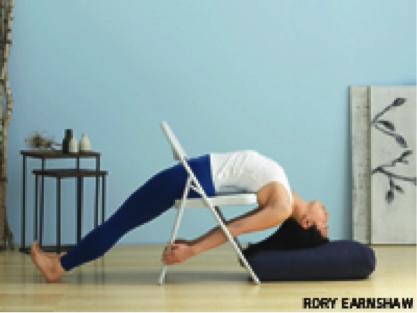
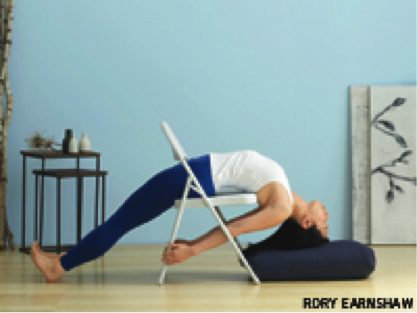
3. Viparita Dandasana (Inverted Staff Pose), supported

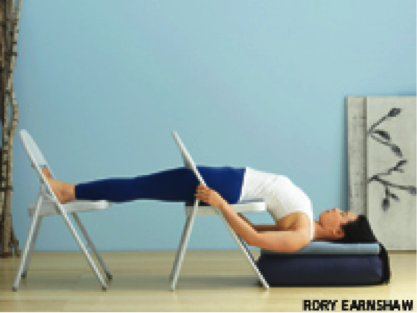
Sit backward through a folding chair, preferably one that has a large opening in the backrest so that you 
have ample space for your legs. Holding on to the sides of the top of the chair, lift and broaden the chest while lying backward over the seat. The edge of the chair seat should support you near the middle of the back. Rest the top of your head on a bolster or folded blankets. Straighten and extend the legs. Open the chest and move your arms in between the front legs of the chair to grasp the back legs of the chair.

If you cannot straighten your legs, raise your heels onto blocks or some other support. Hold for 5 minutes. To come out of the pose, hold near the top of the chair, bend your knees, put your feet flat on the floor, and keep your chest open as you pull yourself up. Once upright, stay for a few moments with your eyes closed.

Viparita Dandasana (Inverted Staff Pose), supported

4. Setu Bandha Sarvangasana (Bridge Pose), supported

Keep the props set up as in the previous pose, but add a second chair for your feet and more support (a second bolster or more blankets) for your head. As in Viparita Dandasana, hold on to the top of the chair as you lie backward on the seat. Slide off the chair until your shoulders reach the bolster so that your shoulders and head are resting at the same level. Place your feet on the second chair and straighten your legs with the heels apart. Relax the abdomen and allow it to extend. Hold for 5 minutes, and then come out of the pose as you did in Viparita Dandasana.

Setu Bandha Sarvangasana (Bridge Pose), supported

5. Sarvangasana (Shoulderstand), variation

  1. Sarvangasana (Shoulderstand), variation
    This blanket setup is different from the typical Shoulderstand. Here, the head is elevated and the back of the neck lengthens, which allows the face to recede and concentrated tension to dissipate. To begin, roll up one blanket. Then make a thicker roll with two blankets. Open your mat against a wall and place the thin roll against the wall and the thicker roll about 1 foot away from the wall.

Place a bolster lengthwise against the second roll. Lie on the bolster, shoulders on the thick roll and your head on the thin roll. Bend your knees, lift your pelvis, and place your feet on the wall. Walk your feet up the wall and straighten your legs. The thin roll supports the back of the head so that the back of the neck lengthens between the two rolls. If the head touches the wall, move it closer to the bolster. Relax the arms, bend your elbows, and rest the back side of your hands on the floor.

Although you’ll feel a stretch in your neck, most of your weight should be on the shoulders. Your neck should feel relaxed. Do not push the back ribs toward the chest, as you might in other versions of Shoulderstand. Instead, allow the sternum to move away from your chin and the upper back to round slightly. Relax the temples and keep the jaw soft. At first, this variation may feel awkward. Practice it several times to experience the desired effect. If you can, hold for 5 minutes.

Sarvangasana (Shoulderstand), variation

6. Paschimottanasana (Seated Forward Bend), supported

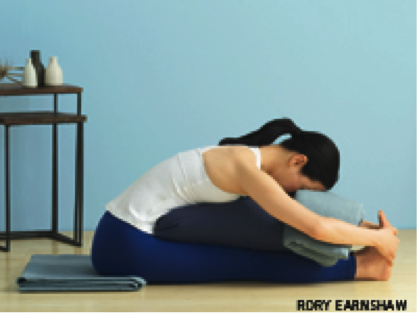
Sit in Dandasana (Staff Pose) with a folded blanket under the buttocks, and put a bolster lengthwise on top of the thighs. Place a folded blanket on top of the end of the bolster closest to your feet. Extend your torso forward over the legs, and catch the feet with your hands. Rest your forehead on the blanket and your abdomen on the bolster for 3 minutes. Use more support if the props aren’t high enough, or place a chair in front of you and prop the bolster against the seat of the chair.

Paschimottanasana (Seated Forward Bend), supported

7. Viparita Karani (Legs-up-the-Wall Pose), supported

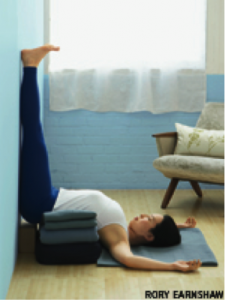
Stack a couple of folded blankets on top of a bolster near a wall. Put a block between the bolster and the wall and a blanket on the floor in front of the bolster for your head and shoulders. Sit on the side of the bolster and roll your sacrum onto it, lifting your legs up the wall. Scoot yourself close to the wall so that the buttocks touch or come near the wall. Gently lower your shoulders and head to the floor.

If you slide off the bolster, you can push yourself closer with your hands on the floor. Straighten your legs and press the thighs into the wall as you open your chest. Rest for 5 minutes. To come down, bend your knees, push your feet into the wall, slide away from the wall, and rest your back on the floor. End your practice by resting for 10 minutes, with eyes covered if you’d like, in Savasana (Corpse Pose).

Viparita Karani (Legs-up-the-Wall Pose), supported

Deepen your practice of Iyengar yoga and experience a new level of self-awareness that brings clarity, peace, and strength. Marla Apt hosts the Iyengar Yoga Immersion at the Art of Living Retreat Center from August 1-4, 2019.

Marla Apt
Marla Apt

Marla Apt, a Senior Intermediate Level certified Iyengar Yoga teacher, is based in Los Angeles, where she teaches public classes and conducts teacher training in addition to teaching workshops in the US and internationally.

This article was originally originally appeared on artoflivingretreatcenter.org/blog and is reposted with permission from the author.

Posted on

Thanks for the LoVe Vinito!

vinito yin yoga ttc

Here another Yinster, check out what Vinito has to say about our training: “I had no idea what to expect when I signed up for the Yin Yoga course. All I knew was that I loved the yin yoga classes I attended in Australia, and wanted to deepen my understanding and practice. The course surpassed my expectations, it was awesome.

Alex and Eva are deep with experience, knowledge and wisdom on yin yoga and how it relates to the body mind and soul. They expertly, clearly, and deeply cover the many elements of yin yoga, such as:

Asanas, the Meridian system, the Daoist 5 elements, the different organs of the body that the different Asanas effect. How to teach a class, and much more.

This information is repeated, gently again and again, to help our systems absorb the information.

The class itself is held in such an encouraging, warm, and supportive holding that overcomes any fears that may come up, and makes you feel that anything and everything is possible. The class was not only deeply informative, it was also fun, and the class I was with became very connected and supportive of each other. New, deep friendships were made. I can highly recommended this course to everyone.” Vinito

Posted on

Spread the Love – Student Recommendation

Camilla - yin yoga teacher training in Goa

“Don’t think, just come! I highly recommend this Yin Yoga teacher training. My month long training was incredibly enriching. I have gained deep insight into the Daoist 5 Elements and Meridian energy flow in the body, and am now equipped with the teaching tools and confidence to take my students (and myself!) on a truly transformational journey.”

Camilla Marsh, Owner of Mamma Shanti, Sri Lanka

Posted on

Meet the amazing healing power of Reiki

head-650878_1280 yin yoga ttc

Reiki is a profound and beautiful subtle form of energy work using guided life force energy. Reiki is the life energy that flows through all living things. It is believed that this Qi (life energy) in our body should be strong, balanced and free-flowing in order to maintain a positive state of health..

A Reiki practitioner taps into this unlimited supply of “life force energy”and uses this energy to heal himself and others. Reiki can be conducted either hands-on, in which several parts of the body are lightly touched by the practitioner’s hands to direct the energy there, or hands-off, where the hands are held slightly above the body. Moreover, as Qi is not limited by distance or time, distant or remote Reiki healing is also possible. Reiki helps to remove energetic blockages in our life force energy, eases tension and stress and helps support the body to facilitate an environment for healing on all levels – physical, mental, and emotional.

The Reiki Initiation (Level 1 and 2) to become a Reiki practitioner is part of our 100hr Yin Yoga Therapy Training and Reiki Healing sessions are part of our Healing Retreats. Check out our web page for more info.

Posted on

Student Recommendations

Yael - Yin yoga teacher 200 hr certification course

Here is what our student Yael had to say after her Yin teacher training with us. It’s nice to share the love, thank you Yael!

“I had the pleasure of doing a 200 Yin Yoga TTC with Alex and Eva. Both of them are amazing people who love to share their knowledge, I got so much information! Meridians, asanas, the human body and more. There wasn’t a question that was left unanswered. One of my favourite parts was that we began teaching ourselves as soon as possible, so we got to practice the theory first-hand multiple times. Their energy created a safe space to succeed and fail. Every student’s class was analysed in order to give us a better understanding of how to improve according to our abilities and personalities. In the end what I loved most was that Alex and Eva are truly passionate about what they’re doing and are generous with sharing it.”

– Yael Kovalivker

Posted on

Pose of the Week – Dangling

dangeling yin yoga ttc

Looking for some foundation? Go Dangling! The Dangling pose is a beautiful grounding pose, while working on your spine and lower back. A perfect pose for some true connection, stillness and relaxation.

When?

If you are suffering from anxiety or stress then this is a great pose to do, because it releases the upper body, head and shoulders. It is an inversion, so we are relaxing the heart and strengthening our blood vessels, this can help to prevent heart and brain stroke. Focusing on letting it all go by hanging upside down will help you to find the stillness your body and mind needs. Also, this pose can help you to get rid of lower back trouble. Having your period and suffering from cramps? The Dangling will help to relief this nagging pain.

How?

The Dangling is probably the easiest pose to come into. You simply stand up with the feed hip-width apart, you may bend your knees and you slowly fold forward. Hold your opposite elbows with the hands and relax. Stay in the pose for 2 to 3 minutes and to come out you bend your knees a little bit more, release your hands to the ground and slowly, vertebrae by vertebrae, you roll up to standing.

Benefits
  • Stretches the lower spine
  • Loosens the hamstrings
  • Compresses and activates our stomach
  • Massages abdominal organs
  • Meridian lines of Urinary Bladder is stimulated
  • Meridians lines of Kidney, Stomach and Spleen are compressed and detoxed