Posted on

5 Tips on Finding Balance this  Autumn

yin yoga vajrasana

We are starting to welcome the new season here in Goa… After the monsoon, Goa starts to burst into life and by November we are blossoming. I have been living this seasonal life for 20 years and have been welcoming students to the yin side now for almost ten years. After the monsoon rains, we are nourished – the landscape is vibrant green – 50 shades of Green!

Beyond the palm trees that dot the beaches and roads, there are rice fields, cashew trees bright hibiscus flowers and swooping turquoise kingfishers – come and immerse your senses in Goa.

The seasons here in Goa are different – but we are still entering the cooler Winter months here in India. No matter what season you find yourself in at home there are a few key areas we can focus on in order to find a sense of balance. The shift in seasons is always challenging. Autumn is naturally a time to go inwards – our rhythm changes at this time of year. Yin Yoga supports this journey inwards with poses to help us direct our awareness inwards and create stability and clarity.

5 Tips on Finding Balance this Autumn

1 – Get Grounded in your Yoga – Forward bends quieten the mind

Autumn can intensify anxiety – the wind can literally get under our skin and make us feel unsettled. When we bring our forehead to the earth in Childs Pose – it has a calming and grounding effect.

5 Tips on Finding Balance this Autumn

I really love the Deer Twist – I find it very grounding and supportive.

Sit in Butterly pose with the soles of the feet together and place a bolster next to your right hip – swing the left leg behind you and rest down with your torso onto the bolster – relax through the arms, hands and upper back. Feel the chest to the bolster – grounding the breath. A beautiful pose to stay for 5 min. Naturally, then swap the bolster and do it on the other side.

5 Tips on Finding Balance this Autumn
2 – Boost the Lung Meridian and Open the Chest

The lung meridian is not only a help in supporting our immunity, but in Daoist philosophy, they are also representing the element of metal, and its season is autumn. So tuning into the autumn vibes with some lung meridian activating poses is an excellent idea.

There are many yin yoga poses to help create space in the chest – Here are a couple of our favourites. We need to tune into the energy of breath at this time of year boosting our respiratory system.

Melting Heart Pose (Anahatasana)

Come onto all fours – knees slightly wider than hip-width apart and hips over the knees. Bring your chin to the earth and walk your hands out to the edge of your mat – you can rest your forearms on the ground. Feel a sense of spaciousness in the ribs and an expansive quality in the upper back – breathe into the sensation of expansion at the back of the heart (upper back). It will stimulate the heart and lung meridians if the arms are extended. For beginners, you can pad the knees with a blanket. Hold and surrender for 3-5 minutes.

5 Tips on Finding Balance this Autumn

Closed / Embracing Wings

Just cross your arm under your chest. You can give yourself a little hug by placing your hands on your shoulder blades or just releasing them to the ground. You might want to explore if you feel better with a little support under your forehead. Stay for 3 min and switch the crossing of the arms, but as always in our practice, if you feel too much compression listen to your body and soften. A nice rebound is needed after the pose to release the compressed lung meridian flow.

5 Tips on Finding Balance this Autumn

Open Wing

From laying on your front, stretch the arm out and roll over towards your back until you feel that sensation of your edge in your shoulders. Explore if you like to bring your upper leg up to create a bit more leverage or you also can just simply keep laying on your side. This pose opens our deltopectoral triangle beautifully to stretch out the lung meridian.

5 Tips on Finding Balance this Autumn
3 – Acupressure Point for Lung or Immunity

LU 7 is my most favourite point to address the lung meridian and it is a key point for boosting the immune system. It is excellent for runny noses, congestion, chills and fever, scratchy throat and sneezing because it is basically activating your body’s response to viral attacks.

LU7 is your bodyguard, fighting off viruses and bacteria.

Traditional Uses:

  • Stimulates the descending and dispersing of lung qi
  • Relieves respiratory diseases
  • Relieves scratchy throat, runny nose, congestion, sneezing
  • Relieves chills/fever and body aches
  • Main point to release neck pain

How to locate Lung 7:

  • Bring your hands together to a “thumb shake”
  • Place the index finger of the other hand behind the inside wrist
  • Find the point just right under your index finger tip
4 – Pamper yourself with VEGAN GOLDEN MILK

Our version of the ayurvedic classic uses either a light coconut milk or almond milk if you have it – and if you can combine both you create a creamier version (pure coconut milk can be too heavy – while oat or rice milk can be too light). And actually ground turmeric is not only more easily available but actually gives a stronger flavour in a shorter amount of time. And don’t forget the black pepper.

In our version we make a turmeric paste first and then add to the milk – so it might take longer than some recipes – but you can always make extra paste and keep it in the refrigerator for up to a month.

Put half a cup of water into a saucepan on a low heat and add 1 teaspoon of turmeric – you can also add a cardamom pod for added flavour – and add a twist of black pepper as this activates the active ingredients within the turmeric. Simmer to a paste like consistency for about 8 minutes.

At the same time you can gently heat your plant based milk (we recommend half/half coconut and almond) with 1 tsp of almond oil (so good for your joints at this time of year) until it boils – then take off the heat.

Then mix the two in a blender or whisk it up. Some people like to add a sweetener or honey.

Naturally you can make more of the paste by just increasing the ingredient ratio and refrigerate.

And lastly, put some love in your Golden Milk and enjoy some warm sips and a mindful moment.

5 Tips on Finding Balance this Autumn
5 – Get out

Even though it is getting cooler and the days are drawing in – get out in Nature. Wrap up warm, take a flask of herbal or green tea and get outside. It is good to get some light into your eyes. Ideally, nature is best so wander to the forest, by the river or a coastal walk – but if that’s not possible still try and walk the city streets. Look up – get the daylight in. If it’s windy it might be a good idea to cover your ears and wrap in a scarf – cool winds can really upset our nervous system.

In need of a change of perspective? Want to sink your feet into the sand as you watch a Goan sunset? Ready to tune into the receptivity of your body and mind through yin yoga? Join us this season for a yoga training that will bring you back home to yourself.

Join us to bring more Yin to the world!

Brightest autumn blessings,

Alex & Your YinLove Team

Posted on

How Yoga Can Ignite Your Feminine Energy

yin yoga certification celebrations 2

As we move through our lives, we pass through different stages and changes. A woman’s body will go through puberty, motherhood, menopause, fertility, ovulation, menstruation, and many other changes. Fortunately, yoga can teach us to be open and receptive to changes, and it may assist us in developing a reaction, an adaptation, and a much-needed balance. By honoring the feminine in all of us, we may gain inner knowledge, flexibility in our bodies and minds, and the courage to be passionately loyal to ourselves. One way to channel that feminine energy is through yoga. As a result, in this article, we will show you how yoga can ignite your feminine energy and bring out the goddess in you.

Why should you ignite your feminine energy?

Society asks us to be strong, decisive, logical, controlled, strategic, and have a solution-oriented way of thinking. And we do that perfectly in our daily lives without even thinking about it. However, those are the masculine energy values, and masculine and feminine energy are equally significant and needed in everyone, regardless of gender. Therefore, the balance of these two energies determines the harmony of your connections with others. As a result, learning how to call upon your feminine energy is essential. It will help you rediscover your flow, love, patience, emotions, intuition, and empathy. And fortunately enough, yoga can help you rediscover and reconnect with your feminine energy. Here is how:

AYin and Yang simbol on a paper.

You must balance your Yin and Yang energy to live in harmony.

Yoga poses that can ignite your feminine energy

While the sun governs male energy (Yang), which focuses on objectives, advancement, and strength, the moon governs feminine energy (Yin), focused on nurturing, creativity, and flow. You can channel both of these energies through yoga practices.

Yin Yoga allows us to experience the full introspective and soothing advantages of yoga without the physical exertion of Yang yoga. It is a slow-paced yoga practice in which meditation, mindfulness, and inner calm prepare the mind and body for the practice’s benefits.

So, roll out your mat, and get comfy. We are about to show you how to ignite your feminine energy.

Sitting mountain pose / Vajrasana

This pose can help you open your heart and feel strong and serene. To enter this pose, kneel on the mat, keep your knees pointing forward, and your feet spread behind you. Sit back on your heels, and keep your back straight. You can place a pillow beneath your buttocks or knees for more comfort. If you cannot kneel, sit on a chair so your spine remains straight rather than bent. Relax your shoulders and maintain your chest open. Breathe deeply and gently to help your body and mind relax. Imagine yourself rooted like a mountain, energy passing through your spine and releasing power and tranquility.

yin yoga vajrasana

Yin yoga Varjasana

The sitting mountain pose is not just good for channeling your feminine energy. In reality, this pose, like many other yoga poses, can help you in addiction recovery. That can benefit your mental health and assist you in learning how to relax and have a clear head when coping with cravings. The sitting mountain pose welcomes stillness into the body that will keep your mind quiet so you can focus on yourself.

Butterfly pose

The most magnificent of poses, butterfly, allows us to passively open our hips and hearts while also allowing us to relax fully. To enter the butterfly pose, sit on your mat with your legs stretched in front of you. Then, bring your feet together and bring them towards yourself in a diamond shape with your knees pointing out. Clasp your feet gently and slowly lower your legs toward the floor by bringing your weight in your forearms restiong your upper thighs. As a variation, lie down on your back and rest your hands on your stomach or above your head.

Woman doing the butterfly yoga pose.

The butterfly pose is one of the simplest yoga poses you can use to ignite your feminine energy.

Squat pose

This pose requires you to do a low squat that will stretch your thighs and help you embrace the power of your body. While your legs are hard at work sustaining the position, you will undoubtedly feel the growth in the lower body. The squat pose is also excellent for relieving menstrual cramps.

To enter this pose, begin in the mountain position (standing up straight), bring your legs outwards, and raise your hands over your head with palms together. Pull your belly button inwards and tilt the pelvis slightly. Anchor your heels to the ground and squat downward slowly. Now all you need to do is maintain the pose for as long as you feel comfortable. If you could use some support, press your elbows on the inside of the knees. That will help you open the hip flexors.

In addition to all those lovely yin poses we can also find the yin in the yang, see here our suggestions:
Goddess pose

Goddess pose can truly spark that tremendous energy that dwells within you. This pose is all about bringing forth your inner goddess. And, like a goddess, this pose is powerful – it demands a lot of strength, stamina, and determination.

Therefore, step on the mat, keep the heels in and the toes out, stretch your spine, inhale deeply and reach your arms high. Exhale, bend the knees, engage the core, and sink deep into the hips. If you like moving your body, you can try spiraling. Sway from one foot to the other, release tension in the spine, hips, waist, and belly, and rediscover your inner strength.

Tree pose

This pose is all about regaining balance and harmony. The focus necessary to maintain stability can contribute to a sense of serenity and calm. To enter the pose, stand tall on your mat and put your weight on your left foot. Bring your hands to your heart or above your head with palms together, towards the ceiling. Then, start raising your right foot inward, towards your left thigh. Draw the knee back to open the hip. Stay in this position as long as you are comfortable, then switch legs.

Final thoughts

Practicing yoga poses allows you to channel your feminine energy, feel more balanced, and rediscover your strengths. Therefore, anytime you need to be reminded of just how magnificent you are, use yoga to ignite your feminine energy. Practice the poses we presented, and resurrect the powerful goddess inside you.

moon yin yoga ttc blog
Posted on

7 Myths About Yoga You Should Stop Believing

One of the biggest myths about Yoga is that it’s only for women.

Hearing the word “yoga” probably has you thinking about “twist-you-into-a-pretzel” kind of positions that you would never dream of trying to get into – much less out of! But that’s not the case! You don’t have to put your legs behind your ears, wrap them around your neck, or bend this or that way like you’re Mister Fantastic from Marvel’s Fantastic Four. You don’t even have to be able to reach your toes to start practicing yoga. And, come to think of it, many of our notions about this ancient practice tend to be myths desperately screaming for a debunking session. And today, Yin Yoga Therapy Training attempts to clear a few of them up. Here are seven myths about yoga you should stop believing right now.

1. You have to be flexible to start

“Me, do yoga? I can’t even touch my toes!” There’s a thought that has probably crossed your mind in the past! And, given how Instagram archives are jam-packed with yogis acting like acrobats and contortionists, it’s no wonder you believe that. Nevertheless, that’s not at all what real yoga is about. Let’s look at the bigger picture. Real yoga is about mindful movement, an attitude of presence, self-regulation, self-acceptance, breathwork, and meditation. And, in no way does it require you to be flexible or have a “yoga body” to start practicing.

On the contrary: yoga helps you improve your flexibility, balance, and stamina. It’s the result of regular yoga practice, never a requirement. So, do not allow these thoughts to hold you back from taking a class. Take a leap! The development comes with practice.

2. Yoga doesn’t count as exercise

At first glance, yoga may seem mellow compared to CrossFit and Insanity Workouts, so we get why you’re skeptical. But, make no mistake, yoga will make you sweat.

Yoga meets all the requirements for core work, strength, flexibility, and balance training. Some styles can even help you reap some aerobic benefits. So, it is an incredible way to improve your overall fitness level, help you shape up, and reduce the risk of injury. Also, it relieves muscle and back pain and improves flexibility, endurance, balance, and posture. Therefore, those watered-down stretching classes with rows of mats topped by people resting in Savasana may be a part of it, but they aren’t the be-all-end-all of the practice.

surfing-image-soul yin yoga ttc

Yoga is a great way to improve your fitness level and get in shape.

There are more than 100 different styles of yoga – from Hatha, which combines a series of basic movements with breathing, and Yin, which is slower and more meditative, to Ashtanga or Bikram yoga, both of which can make you break some serious sweat. The intensity level depends on the type of yoga you choose, but generally, the flows go far beyond the Child’s pose, Dead Corpse pose, and other sleep-promoting positions. It’s just one of the many yoga myths you must stop believing.

3. It’s nothing more than a series of stretches

If your excuses for not doing yoga are based on the belief that it was nothing but boring old stretching, boy, are you in for a nice surprise. On the surface, that’s what it might look like. And sure, there are a few overlaps. However, yoga is all but boring. And it’s not nearly as simple as doing a few simple stretches.

Yoga focuses on mind, body, and spirit balance, helping people go within to establish a connection between these three aspects of being.

We’ve already discussed the physical aspect, but just like any other form of exercise, yoga and meditation also have numerous proven mental health benefits. For starters, they can modulate brain mechanisms that impact our behavior, thus helping us keep stress and anxiety away, improving our cardiovascular fitness level, and changing our emotional response to life.

But yoga goes beyond a toned body, the ability to master a handstand, or half an hour of peace away from the office. Ask a yogi what truly makes yoga special, and their answer will be spirituality. Practicing yoga allows you to take the time to slow down and focus inward to get rid of the negative, restore your spirit, and calm your mind. It cultivates awareness of the spiritual energy, transforms your mind, and gives you calmness of mind and spirit.

4. The more difficult the pose, the better

Yoga newbies often confuse the ability to pull off more advanced poses with spiritual superiority. But the truth is, no amount of Insta-worthy postures, deep backbends, fancy arm balance, or crazy headstands on your yoga mat can help you discover the joy and profound wellbeing that the practice offers. This is nothing more than one of the common misconceptions related to yoga practice. In fact, it is even recommended that beginners take a gentler, simpler, and softer approach.

Being able to do crazy poses does not mean you’re better at yoga.

5. Yoga is too easy

Next on our list of myths about yoga you need to leave behind is that it is way too easy or passive. It is actually a combination of both simple and challenging asanas. The fun fact about this incredible practice? You can master some postures in a matter of days, whereas others may take months or more to fine-tune. So, don’t knock it ’till you try it! Of course, practicing it daily and challenging your physique without forgoing your focus is essential.

6. Yoga is too hard

And then there’s the opposite end of the spectrum – those who fear it will be too difficult. Granted. Some asanas can seem quite intimidating, making you think: Naah, my body “doesn’t go that way.” But that’s the beautiful thing about yoga – it meets you where you are. The whole idea is not to force yourself into an asana. Instead, take things slowly, listen to your body’s signals, adapt the pose to your comfort level, and choose poses that feel best for you. Only after you’ve become more comfortable with yourself in the practice should you explore other more complex poses.

7. Yoga is not for men

The chances are that you’ve heard at least one man in your life say that guys don’t do yoga. Or, maybe you are that man. After all, all that emphasis on flexibility, calmness, breathing, and spirituality, it must be a girl thing, right? How could controlled breathing possibly help me gain muscles?

One of the biggest myths about Yoga is that it’s only for women.

One of the biggest myths about Yoga is that it’s only for women. 

Nevertheless, what’s interesting about this is that it’s all contrary to the history of the practice. Did you know that yoga used to be for men – and only for men? That’s right; the asanas passed down to us were recorded by the male yogi Patanjali around 600 B.C.E. in the Yoga Sutras. The practitioners in the past were almost always men. The western world has picked up yoga thanks to men. Even the founder of the famous Bikram yoga was – yes, you guessed it – a man.

And then there’s the obvious! Yes, yoga is predominantly practiced by women. However, it is incorrect to explicitly tie yoga, or any other physical activity, to women. Yoga is for everyone; it is gender-neutral. So, ignoring such myths about yoga and stereotypes surrounding it as a tradition is essential.

Posted on

#YinYogaLove

I have a body
I have breath
I have thoughts, but I am not my thoughts
I have energies and powers inside of me, some I was born with, some I create, stimulate, and balance as I need.

There is a physical world around me, I know I can have a positive impact on it; however, I move with the seasons and remember not to push only to flow and nurture the change I wish to see in the world. I trust when the time is right it will be so.

There are also many people around me. I intend to interact with all of whom cross my path with openness, love, and kindness however never at the expense of my own humanness nor self-love.

I give and I receive
I manifest and I adapt
I stretch and I compress
I am soft and I am powerful.

The benefits of Yin yoga are a touch like the fascia it works with, you can try and simplify it and say it works on different layers – the physical body, the energetic or spiritual body and the mind. However, like fascia it is more like an interconnected web of benefits. A web of benefits that supports the creation of a balanced lifestyle, or Wu Wei. The benefits of yin accumulate to a human experience in which we can stand in our own power, beauty and wonder whilst equally moving with and flowing with the ebbs and flows of the universal seasons.

However, our human minds still prefer the logical and analytical so let’s take this layer by layer.

The physical body

Yin yoga is a practice is for any and all body types, it is one of the most accessible styles of yoga as it honours the concept that functional alignment is greater than ecstatic alignment. Within yin practice there is space for modifications for all bone structures and body types. “I’m not flexible so I can’t do yoga” doesn’t cut it here.

If we strip it back to anatomy yin yoga works with ‘yin tissues’ this includes joints, bones, ligaments, and fascia.

Joints – Yin supports the rejuvenation and maintenance of our joints, by compressing our joints we are stimulating the production of synovial fluid which is responsible for the lubrication and health of our joints.

Fascia- the fascia is a type of connective tissue that essentially holds all our bones, muscles and organs in place without it we would be a puddle of bones, organs and skin on the floor yin yoga we take passive long holds to stretch the fascia, this stretching creates space and releases tensions in the body, increases range of motion, reduces feelings of stiffness and improves circulation. Fascia is also responsible for our sense of proprioception (our ability to know where our body is in space). By working with our fascia, we are developing a strong sense of body awareness, which physically supports our motor planning, sequencing and execution which translates to improved skill acquisition in relation to any new skill.

There is much we don’t know about fascia however there is exciting emerging research around its functions and roles within the body. Some neuroscientists are coming to believe that fascia is capable of carrying conscious thought, meaning yin will allow and create a strong body-mind connection. There have also been studies on the impact healthy fascia can have on cancer recovery and autoimmune disease.

The energetic body

Yin is a powerful modality to develop an awareness and understanding of the energetic body.

Yin is based on the Traditional Chinese Medicine concept of the meridian system and the flow of chi. The meridians are pathways in which chi flows. Chi refers to our life force energy sometimes referred to as prana. Throughout different stages of life our chi can become stagnant, and it can also be overactive in various areas of our body. The practice of yin helps to balance our chi by stimulating and compressing our meridians the end goal is to have free-flowing chi around the whole body. Yin also offers a space in which we take the time to feel the flow of our chi.

Being in contact and having awareness of our chi and our meridian system is an unbelievably helpful tool in understanding our emotions and how we can work to regulate them.

We have 12 major meridians all of our meridians have various emotions and characteristics associated with them. Meaning that depending on what energies, emotions or life situations are present we can use certain yin postures to work toward free-flowing chi in the associated meridian.

Below are our main meridians and just one of the many examples of life situations/ emotional states associated with them.

Urinary Bladder Meridian – It can be helpful to work with the UB when we are experiencing nervous system dysregulation and to stimulate a parasympathetic state.

Kidney Meridian – Working with the kidney meridian can be a powerful tool in learning how to respond to fear particularly when faced with change or challenges it allows us to tap into a general trust in life and ability and trust in universal guidance.

Liver Meridian – Working with the liver meridian is useful when dealing with feelings of frustration and anger that emerge from plans gone wrong. The liver can help us to gain perspective, develop cognitive flexibility and learn to overcome barriers.

Gallbladder Meridian – Working with the gallbladder energy helps us to tap into our sense of courage helping us to make decisions and follow plans. Less talk more action!

Stomach Meridian – Activating the stomach meridian promotes the nourishing and nurturing of ourselves and the people around us in an appropriate manner.

Spleen Meridian – Working with the spleen is helpful for any of those who tend to overthink, healthy chi flow of the spleen promotes mindfulness and one thing at a time mentality. No hurry, no worry, no sorry!

Heart Meridian – Working with the heart vibration we cultivate a sense of joy, passion, and laughter we remember to be playful and lean into joy.

Small Intestines Meridian – Working with the small intestines energy can help us to become more in sync with those around us supporting connection and interaction with another.

Lung Meridian – With this energy in balance we know how to be with strong emotions like sadness, sorrow and grief without trying to hide them, fix them or fade them.

Large Intestine Meridian – Great to tap into during a full moon ritual or in the waning moon phase, the ultimate energy you need to let go of what no longer serves you!

The mind

The process of yin promotes the development of mindfulness. Yin has a superpower in challenging the western “go go go”, “rise and grind” lifestyle. Yin allows us to firstly slow down, gain awareness of our thoughts, separate ourselves from our thought and realise importantly that we are not our thoughts. Our thoughts can say whatever they want to say at the end of the day they have no real power over us, we always have choice and control over our actions and how we show up in this world.

Let’s look at an example: You’re in a yin class and so far you have been enjoying some gentle forward fold and you are excited to continue to enjoy a nice relaxing gentle sequence but then the teacher tells you, “and now 5 minutes in frog” your thoughts tell you ff off, not happening, give up, they tell you that it’s too much, that wasn’t what I was expecting, that you can’t do it, you feel angry and frustrated. However instead of hooking onto these thoughts and feelings you unhook, you let them drift around. Slowly time passes, you begin to sink into the pose you create some space physically but also mentally for these thoughts to come and go, the intensity of the thought reduces and what’s this? You are actually beginning to enjoy the sensations. Now the teacher tells you it’s time to find your rebound.

The cognitive skills displayed here are extensive.

  1. Emotional awareness
  2. Awareness of thoughts
  3. Cognitive flexibility, there was an unexpected obstacle to a plan, and you overcame it
  4. Mindfulness

Yin yoga importantly creates harmony in our lives bringing together our mind, body and energetic field helping us to connect to mother earth and equally the universe.

Colleen Mann, Yin Yoga Therapy Ambassador Australia

Posted on

Connecting to your yin side in a yang world

yin yoga teacher training maldives girl

We live in a very yang-dominated world. We are constantly on the go, we are multitasking,yin yoga teacher training maldives girlnotifications are always ticking in on our phones, our schedules are jam-packed, we have endless to-do lists, and we are always being encouraged to achieve more, make more money, buy a bigger house, work longer and harder, get more results, just do more… Always do more.

Our modern yang-dominated lifestyle desperately calls for balance. Daily stress is impacting our bodies, minds, and souls. Perhaps we keep going because we don’t know how to stop. We don’t know how to get out of the hamster wheel. We simply don’t know of any other way to keep up.

At the same time, we long for ease. To just be. We long for enjoying life just as it is, without this constant doing and achieving.

This is where yin comes in.

Yang is the action of doing, yin is the ability to receive.

Right now our world – and ourselves – is unbalanced. We are lacking the yin, the introspective. When looking at how we live our lives it is no wonder that stress and anxiety are on the rise. There is too much yang and much too little yin. Too much doing and not enough being.

That is why it is so important to consciously connect to our yin side. If we are to restore balance in the world and within ourselves incorporating yin practices into your life is essential. But the world we live in is never going to tell us this, we must consciously choose to connect to our yin side and embrace and cultivate the ability to sit and listen closely.

The Yin Yoga Therapy practice is designed to create space for just that. To unwind your body, clear your mind, and open your heart. To allow energetic healing and balance to take place.

Yin Yoga is more than just physical stretching and rejuvenation. Yin Yoga can be an art, a philosophy and a way of living.

But practising yin yoga is just one way you can connect to your yin side. There are many more yin practices you can incorporate into your daily life so you start to balance the yin and the yang.

A few yin practices we love:

☯️ Naturally, we love Yin Yoga. Practising Yin Yoga 2-3 times a week will not only help you with your body’s flexibility and stability, it will also give you a profound sense of calm and relaxation.

☯️ Go into nature. Nature is so healing. Get your feet dirty. Dance in the forest. Swim in the ocean. Hug a tree. Breath in the fresh mountain air. Watch sunrises and sunsets. Walk barefooted in the grass. Just connect with Mother Earth.

☯️ Dan Tien breathing. Breathe all the way into your belly. Allow your belly to expand gently on each inhalation, exhale fully, let it all go. By breathing deeply you activate the parasympathetic nervous system (rest and digest) and you will start to notice how your body becomes more and more relaxed.

☯️ Turn off your phone. Yes, we need our phones for work and staying connected with our friends and family and just the world in general. But it is so important to also take time to disconnect and not be on your phone. Perhaps set your phone on airplane mode every night and don’t turn it on until after you have had a bit of quiet time in the morning to just be.

☯️ Be still. Just sit with a cup of tea and enjoy your life. No phone, no magazines, no music, no podcasts. Allow yourself to just be.

☯️ Create your own yin rituals. Sweeten that tea with a dash of cinnamon, put love instead of sugar. Drink it sitting on your favourite spot on the ground, rooting yourself while lighting a candle and applying your preferred aroma oil on your wrists.

☯️ Nourish yourself by mindfully preparing your food fresh, sprinkling some blessings over it.

We hope these practices will help bring some balance to your life. Remember, connecting to your yin side doesn’t have to be a big thing. It can be as simple as just sitting down and taking a few deep, nourishing breaths while allowing all your worries, cares and stressors to float away.

Posted on

Choose Love Over Fear

Choose Love Over Fear

We recently posted a post on Instagram about choosing love over fear and thought we wanted to talk more about this topic in an email.

In life, it can be so easy to choose fear over love. It is all too easy to let fear take the steering wheel and let fear decide the course of your life. How many of us have decided against doing something simply because we were fearful? How many people never get around to starting their own business, becoming yoga teachers, or taking a chance in love because they are afraid?

All too many people allow fear to control and dictate their life.

Of course, fear can also be good. We need fear in order to survive. If we didn’t feel fear we would walk out in front of cars, and we would do stupid, dangerous things. However, when fear is holding us back from living life to our fullest potential it becomes problematic.

You can feel fearful but still, have the courage to do it anyway.

Fear will always be present, but that doesn’t mean you have to live your life from a place of fear. Perhaps you are afraid to start a new relationship because you were so hurt in your last relationship. This is a prime example of choosing fear over love. Or perhaps you know in your heart that you are meant to teach and share yoga with the world, but you are worried what other people will think of you, that you never get around to signing up for a teacher training. Or perhaps you want to start your own business, but you’re afraid to leave your cushy 9-5 job so by the time you’re 60 years old, you still don’t have a business.

Here’s the thing. Every single day people choose fear over love and faith.

However, we have the choice to live our life from a place of love and faith. It doesn’t mean that fear isn’t present, it just means that fear isn’t calling the shots.

When we live life from a place of love and faith, we become brave with our lives. We sign up for that yoga teacher training, we start that business we have been talking about for years, we apply for our dream job, we go on that solo trip to Bali, we say yes to a new romantic relationship, we wear the clothes we love…

We become our truest, most authentic selves and we start to radiate love and light.

Here’s a wonderful quote from Teddy Roosevelt about being courageous with your life:

“It is not the critic who counts; not the man who points out how the strong man stumbles, or where the doer of deeds could have done them better. The credit belongs to the man who is actually in the arena, whose face is marred by dust and sweat and blood; who strives valiantly; who errs, who comes short again and again… who at the best knows in the end the triumph of high achievement, and who at the worst, if he fails, at least fails while daring greatly.”

― Teddy Roosevelt

Posted on

Were attention goes, energy flows ☀️

yin yoga teacher 200 hr certification celebrations

If you have ever attended one of Alex’s yoga classes or one of her healing sessions, then then you undoubtedly have heard Alex say these words more than once:

“Where attention goes, energy flows.”

If you spend your days worrying about how you will ever find a new job, get clients, what will other people say, will there ever be peace in the world, then you are directing your energy into all the wrong things… The truth is there are endless things for us to worry about, but as the saying goes:

Worrying is like a rocking chair: it gives you something to do, but it gets you nowhere.

As human beings, we have a tendency to worry and think about everything that could go wrong. We make up scenarios in our minds that most likely will never happen. When we spend all this time worrying and stressing, that is exactly where all our precious energy flows.

If you dream of starting your own business and travelling the world but you keep worrying about leaving your cushy job, not having a steady income, and everything that could go wrong while travelling, what are the chances of you actually starting your own business and travelling the world for example as a digital nomad? Probably zero to none.

If instead, you focus on actually starting your business, writing down where you will travel to, and generally focus all your attention on how this could actually happen and everything that could go right, guess what? Energy will flow there, and your odds of manifesting your dreams are much higher.

You need to get laser-focused on what it is you really want and let go of all the worrying and the limiting beliefs. Remember: worrying is like praying for what you don’t want, it can become that self-fulfilling prophecy. So focus your attention and energy on your goals and dreams. You will be amazed at what happens once you direct your attention and energy to the right places.

Suddenly you are at the right places at the right times (synchronicity). You meet people who support you. You stumble upon resources that are helpful. You overhear conversations that inspire you. You will be surprised at how fast the universe works once you simply direct your energy where you want it to flow.

This also means focusing on the positive. It can be all too easy to get caught up in negative thinking, self-doubt, and worry. Instead, focus on what is going well. Focus on everything you have to be grateful for. As they say: focus on the good and the good gets better.

Choose gratitude.

Count your blessings.

Choose to believe that even your wildest, craziest dreams can come true.

And then, as Alex often says as well:

“A little courage is needed, growth happens outside your comfort zone.

And I promise you, just there, a little over that edge, you will discover the best version of yourself.”

Tune in. Stay yin. Brightest Blessings,

– Your Yin-Love Team

Posted on

Top 5 Benefits of Using Essential Oils for your Yoga Practice

dragon yoga twist pose yin yoga teacher training

Yoga is now one of the most preferred physical fitness and mental exercises developed to enhance the overall well-being of the mind, body, and soul. Yoga has tremendous physical and mental health benefits, which can be achieved only through regular yoga practice.

While there are many other forms for gaining strength and flexibility, yoga is still considered one of the best forms. The reason behind this enormous popularity of yoga is its amalgamation with many natural techniques to attain inner peace and provide comfort to the muscles during workout sessions. One such technique that helps you deal with your daily stress level or tiredness by giving you a soothing experience is essential oil therapy.

If you are unaware of the benefits associated with essential oils, you are missing out on something really beneficial to your well-being. They are considered one of the most effective ways to deal with many common ailments without spending much time or money.

Essential oils are organic compounds used for various purposes like flavors, scents, etc. These oils come from plants and their different parts, roots, bark, seeds, etc. The potent scent of these plant-based compounds is depicted by its name “essential.” This essential oil therapy has proved to be extremely helpful in enhancing the quality of yoga practice when dealing with muscle pain after strenuous workout sessions. Here we would like to discuss some essential benefits associated with using essential oil during yoga practice:

1. Relieves Muscle Aches and Pains

One of the significant reasons behind muscle pain after a yoga session is stretched or contracted muscles that are not given enough time to relax properly. Using essential oils for alleviating your muscle aches and pains would be helpful since these compounds have an anti-inflammatory property that helps in diminishing any irritation caused by overused muscles. It also reduces the recovery period after a strenuous workout session. The best way to apply these essential oils during yoga practice is through a massage or by putting a small amount on your Yoga mat.

2. Promotes Serenity and Positive Energy

One name comes to our mind regarding spices, i.e., “Cardamom.” It is one of the most common spices found in different types of cuisines worldwide. Cardamom has its benefits in providing serenity and positive energy to our body when used during yoga practice. Since cardamom works wonders when promoting your overall wellness, it can help you during yoga sessions for various reasons like nausea, indigestion, etc.

3. Relieves Stress and Anxiety

Who doesn’t get stressed out? Many factors keep on stressing us every day, including the financial crisis, poor health conditions, the workload at the office, etc. The modern lifestyle leads to stress because of a lack of time management and dealing with multiple problems simultaneously.

The most beneficial way to reduce the mental stress from our daily routine is through aromatherapy involving aromatic compounds like essential oils. The best part about these spices is that they have a soothing effect on our minds and uplift our mood level to relax during yoga sessions. Include lemon essential oil during yoga as it is one of the most easily recognized oils because of its refreshing, energizing, and uplifting scent. You can add a few drops of your favorite oil in a bathtub filled with warm water, or you can put some amount on your Yoga mat before starting your practice.

4. Enhances Blood Circulation and Relaxes Nervous System

In today’s world, when people are stressed out due to their hectic schedule, it often leads to poor blood circulation in our bodies and various other health problems, including anxiety and depression. Aromatherapy has the power to improve our blood circulation and also helps in relaxing our nervous system through its powerful scent. It can help you during yoga sessions since it promotes a relaxed feeling and reduces the recovery time of muscles after an intense workout session.

5. Heals Injuries Fast

Another primary reason behind muscle pain that occurs after strenuous yoga practice is injuries often caused while performing different asanas, which involve holding your body in unusual positions for long hours. The best way to get rid of this kind of injury would be to apply essential oils on your body’s affected area or put a few drops of oil on your Yoga mat before starting a yoga session. These compounds have anti-inflammatory properties that heal your injuries fast, promote blood circulation, and give a soothing effect to your senses.

Wrapping Up!

So these are some of the benefits that you can avail of from using essential oils for yoga practice. By incorporating these compounds in your daily life, you would be able to get rid of pain caused due to overused muscles, stress, and anxiety, heal any injury fast along with getting a relaxed feeling while performing yoga sessions regularly.

If you have any queries related to this topic, please feel free to ask by commenting below! Thanks for reading, and stay connected with our blog for the latest updates.

Posted on

Ahimsa, non-violence

yin yoga teacher training at The Body-Mind-Soul Centre 6

Ahimsa is the first of Patanjali’s Yamas, which are the yogi’s ethical and moral guidelines towards society. Directly translated Ahimsa means non-violence. Himsa means violence. A means non. However, you can expand the definition of Ahimsa to also include compassion, empathy, non-harm, peace, mercy, and love towards all beings. The practice of Ahimsa is called ‘Mahavrtam’ which can be translated to ‘the Great Vow’.

You could see Ahimsa not simply as non-violence but as the opposite of violence: Compassion, mercy, peace, love…

Many yoga practitioners believe by becoming vegetarians/vegans they are practicing Ahimsa. However, Ahimsa is much more than what you choose to eat. If you are vegetarian but you are constantly judging others, you have missed the mark. We are not practicing Ahimsa by judging, condemning, and holding anger towards others.

Violence takes many forms, and it is not only about not harming animals and the environment. Violence can also take the form of judgment, a lack of compassion towards ourselves and others, negative self-talk, negative thoughts, beating yourself up…

Violence can also show up on your yoga mat. If you are constantly thinking thoughts like: I’m too big to do this pose, why don’t I have a body like hers, I’m bad because I can’t get my leg behind my head… Then you are not practicing Ahimsa in your yoga practice. Practice with the body you have. The perfect body for yoga is the one you already have. Don’t starve yourself and don’t force your body into shapes and poses that clearly are an act of violence against your body. Listen to your body, and do your practice with love and kindness for yourself.

If you like to find out more, in all our 200-hour courses like the Yin & Yoga Foundations Teacher Training Course 200 Hours we look deeper into subjects like this.

When practicing Ahimsa try cultivating an attitude of acceptance, tolerance, and compassion for yourself and others. Make peace with yourself, your failures, your successes, and your body.

If eating a vegetarian or vegan diet feels right, do it. But do not force it upon others and do not judge others. That is not practicing Ahimsa. Many yogis do at some point in their practice start to feel overwhelming compassion for the animals and the earth. But your decision to switch to a vegetarian diet should come from a place of love, not anger. Ahimsa is not about creating dogma and then judging others when they fail to live up to the dogma you have created.

The truth is we all fail at Ahimsa. Every time we speak a harsh word, we feel jealous, we put gas in our tank, we take a flight, we buy vegetables wrapped in plastic, we think negatively about ourselves and others we are, in a way, not practicing ahimsa. But don’t beat yourself up for failing. Forgive yourself and others and move forward with a humble heart.

Live your life while maintaining Ahimsa in thoughts, speech, and actions both when interacting with others and when by yourself. Make peace with yourself and others.

Take a moment to reflect on the following question:

How will you practice Ahimsa today?

Posted on

The yoga butterfly pose – Investigation & A 60 min yin yoga sequence

butterfly pose reclined

As you have probably already guessed from the title of this article, we will be discussing the yoga butterfly in this article. Some people love the yoga butterfly pose and almost just melts into the pose, and it seems like they could stay there for an entire yoga class. For others, this is a challenging pose that can bring up a whole range of emotions. Actually, whether or not you find this pose easily accessible or challenging it is not uncommon that emotions rise to the surface. In fact, any time we work with hip openers it is very common to have feelings arise during the pose. But remember; that just means yoga is working.

Yoga Butterfly Pose

Before we dive deeper into the yoga butterfly pose we would like to take a moment to talk a bit about alignment in general, yoga teachers facilitating a space where students can tune in and listen to their bodies, and students taking responsibility for their own body and yoga practice.

If you have been practicing yoga for some time chances are you have heard at least one teacher talking about ‘good alignment’ but what is ‘good alignment’? Is it copying a picture you have seen in a book or on Instagram? Is it having every student in the room looking the exact same in any given pose? Should we all strive for the same aesthetic ideal?

No, we do not believe that is ‘good alignment’, and we don’t believe that you should ever strive to make a pose (any pose) look a certain way. There is no such thing as ‘universal alignment’. We all have unique bodies with different ranges of mobility, flexibility, and strength. We each come with our own story, and to think we can (and should) all look the same in a pose is simply delusional, and it will not lead to anything good.

Take the yoga butterfly pose for instance. Some people have very open hips, and folding forward in the pose will be like the most natural thing in the world for these people. Others, however, may have less open hips, an injury or something else that prevents them from easily folding forward. Both are doing the pose equally correct, and they are working with the body they have.

To assume we should all look the same in a pose is unintelligent, and instead of working with the body we are working against it. Now, this is not to say we should just dismiss alignment altogether. It is more about working with ‘functional alignment’ instead of ‘universal alignment’. This means we work more with each individual body and explore the pose and how it feels rather than thinking we should all have our hands and feet in the exact same place in a pose.

Start tuning into your body and explore the pose and notice how it feels. Think of your yoga teacher’s cues as mere guidelines, and remember to listen to your own body. At the end of the day you are the only one who can feel what is going on in your body, and whether something feels right or wrong. Respect and listen to your teacher’s cues but remember that ultimately you are in control, and there are many right ways to do the same pose.

Yoga butterfly pose – benefits, contraindications, modifications & getting in and out of the pose

In this part of the article we will dive into different aspects of the yoga butterfly pose so you will feel confident and safe practising this pose by yourself after reading this article. And remember; always, always, always listen to your body. If you feel any pain, slowly come out of the pose. Modify if need be, and respect your body’s limitations (both physically and mentally). Never force anything. Simply just let go.

Benefits:
  • Yoga butterfly pose is a really nice way to stretch the lower back.
  • Depending on where you place your feet your hamstrings will get more or less of a stretch. If you place your feet further away from your groin, the hamstrings will get more of a stretch. On the other hand if the feet are closer to the groin, the hamstrings will get less of a stretch.
  • The pose is said to help regulate periods, ovaries function and make childbirth easier.
  • As a little yin specific side note (we will not go into this in this article) we primarily work with/stimulate the kidney and urinary bladder meridians in this pose.
Contraindications:
  • The pose can aggravate sciatica. Therefore you may wish to elevate the hips by sitting on a cushion until the knees are below the hips if you have sciatica. Perhaps you also have to avoid this pose entirely.
  • If you suffer from any lower back disorders that do not allow flexion of the spine, then keep the spine as straight as possible and avoid any rounding of the back. Alternatively you can do the reclined version.
  • If you have suffered whiplash or you have reverse curvature avoid dropping the head down.
Getting into the pose:

This pose is a relatively easy pose to enter, and there’s not much you can do wrong. Come to a seated position and bring the soles of your feet together, and then slide the feet away from you. Depending on your hips and knees you can slide the feet further or less away from your groin. Allow your back to round, fold forward, and lightly rest your hands on your feet or on the floor in front of you depending on what feels the nicest to you. Allow your head to relax.

Coming out of the pose:
  • Slowly come back to seated by rolling back up. Then slowly stretch your legs and come to a nice rebound on your back for a minute or two.
Modifications:
  • You can elevate the hips by sitting on a bolster, cushion or blankets.
  • If you feel too much stress in the neck, you may wish to support your head in your hands and then rest your elbows on your thighs or blocks.
  • If for whatever reason your back is not okay with folding forward in this pose, you can do the reclined version by lying down on the floor (or on a bolster) while keeping the legs in the butterfly position.
Fun thing to do:
  • You can try a Toe Zip, folding your opposite toes into each other. Great stretch for your toe joints, lots of juicy sensations to observe and it can help you to be more grounded and find anchor in your balancing poses.
Joints affected:
  • Hips and lower back/spine
Recommended hold time:
  • We usually recommend students to hold the yoga butterfly pose between three and five minutes. However, please listen to your body and come out of the pose if you need to.
  • If you really love this pose, and you just cannot get enough of it, you can hold it for even longer than five minutes. In fact, you can hold it for as long as you like. You can even read, talk on the phone, watch your favorite TV-show, talk to a friend, eat etc. in this position. If you start sitting in this pose while performing daily tasks you will really start opening up your hips!

As a last little note before we move into the sequence, this pose is usually very nice for pregnant women as it allows the hips to open up and it can help release lower back pain. Both things that many pregnant ladies find very lovely.

60 minute sequence with the yoga butterfly pose

While the butterfly pose is a wonderful pose to do on its own either when you need a little work break, you feel like opening up your hips, or you simply just like sitting in this wonderful pose while chatting to a friend, the pose is also wonderful in yin yoga sequence.

This 60 minute sequence is specifically made for the kidney and urinary bladder meridians (as mentioned earlier the butterfly pose targets both the kidney and urinary bladder meridians). The sequence is lovely for opening up the hips and releasing lower back pain.

You can do this sequence on its own or after a yang practice. Whatever you feel like. Yin yoga can be done any time of the day but we personally love practicing yin yoga in the afternoon or evening as you don’t always feel like working or being super active (both physically and mentally) after yin yoga. Actually, yin yoga is a lovely way to decompress after a long day. It helps calm down the nervous system, and it helps you unwind and get ready for bed.

We have already mentioned it but we cannot stress this enough. Listen to your body while practicing, and if something feels off it probably is off. Pain is always a one-way ticket out of any pose. Respect, listen and honor your body.

Always come in and out of the poses slowly and mindfully, and remember to do a rebound in between the poses where you just relax and refrain from moving. Simply just observe any sensations, feelings and thoughts that have arisen after the pose.

Lastly, you can do savasana for as long as you like but we recommend you spend at least five to ten minutes in savasana. Savasana is just as important as any other pose so don’t skip it.

Now, let’s get to the sequence and we hope you will have a beautiful practice.

Note: you can always refer to yinyoga.com if you have any doubts about any of the poses.

60 minute sequence:

5 min. Meditation + Dan Tien breathing

Start in a comfortable seated position, close your eyes and notice your breath. Just sit here for a couple of minutes while observing your breath, without looking to change it. Now start deeping your breath and breathe all the way into your belly. Exhale fully. This is called the Dan Tien breathing. If possible, see if you can continue to do this deep belly breathing throughout your practice. It will help you relax, let go and just melt into the poses.

After 5 minutes, slowly open your eyes and prepare for the first pose.

3 min. Toe Squat

If possible, stay in Toe Squat (sometimes referred to as Tugged Toe) for two minutes. This pose can be rather intense so if you need to modify the pose by all means do so. If it gets too intense during the pose you can always shift your weight forward while keeping the toes tugged. The Anjali Mudra on the back as seen in the picture is quite intense and optional, but a perfect way to activate upper body meridians as well.

Rebound – on the back

Now, come into a rebound on your back. It’s very important that this rebound is on the back and not on the belly.

4 min. Caterpillar

Again, modify if need be but otherwise simply just enter the pose and stay here for 4 minutes. Surrender to gravity and just let go.

Rebound

Time for rebound again. Simply just roll onto your back

4 min. Butterfly

Now it’s time for Butterfly.

butterfly pose yin yoga teacher training
butterfly pose variation – yin yoga teacher training

Rebound

Once again, slowly roll back so you lie on your back and come into your rebound.

4 min. Dragonfly

Now come into the Dragonfly pose. Again, if you need to modify the pose, please do so. Stay here for 4 minutes. Again, see if you can just let go and surrender to gravity. Don’t force anything. Simply just breathe and let go. Here in the pictures you can see different variations if you like to explore, but a simple forward fold is perfect.

Rebound

Slowly roll onto your back again and come into rebound. Just observe anything that has arisen during the pose.

3 min. Happy Baby

This time stay on your back and come into Happy Baby, and stay here for 3 minutes. This pose usually feels a little bit more intense after a bit of time in the pose. See if you can just relax and breathe deeply.

happy baby yin yoga ttc

Rebound

Again come into rebound lying on your back.

3 min. Sphinx + 2 min. Seal

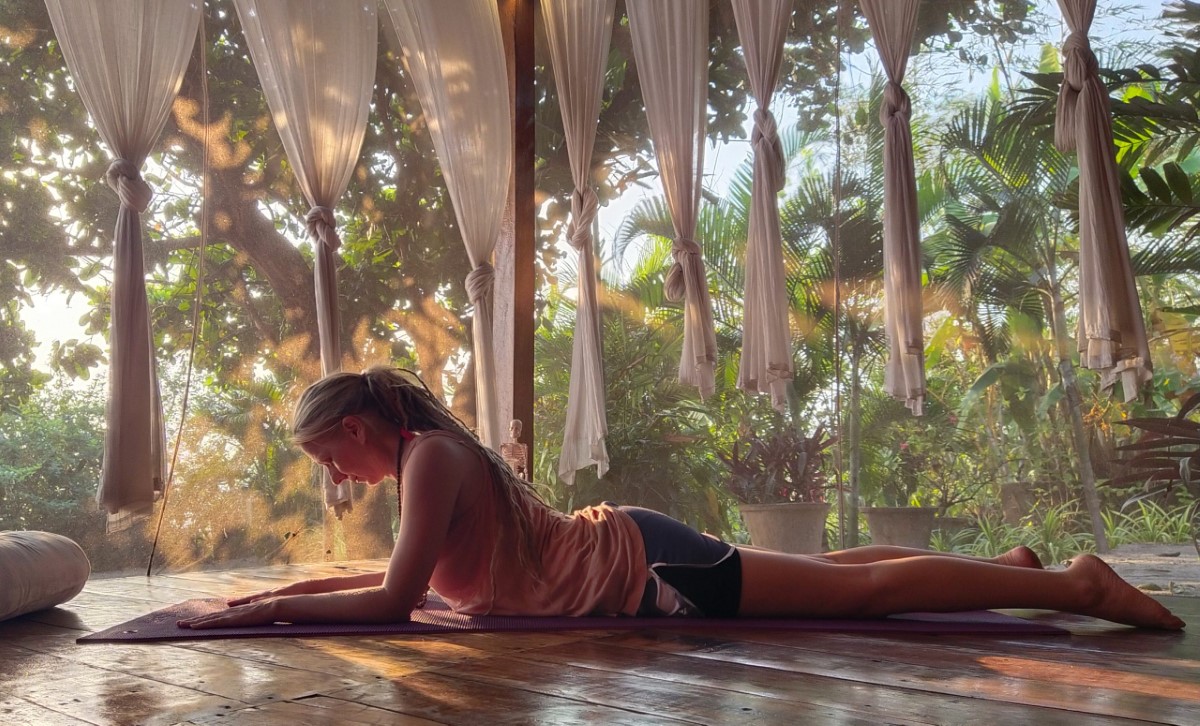
Start by coming into Sphinx on your elbow and stay here for 3 minutes. Relax the space between your shoulder blades, and if possible relax your head and neck too.

If it’s accessible to you, transition from Sphinx into Seal by stretching your elbows. Stay for 2 minutes. If Seal is too much for your lower back, you can stay in Sphinx for another 2 minutes.

Rebound

This time you can do a rebound on your belly. You are also welcome to do the rebound on your back if that is more comfortable for you.

5 min. Back Bend over Bolster

Place the bolster so you can place your back on it and lie down. You can stretch out your legs, but you are also welcome to place your legs in Butterfly position so you are in Reclined Butterfly since this is the theme of this article.

If you are looking for a more physically balanced version of this sequence for your hips, now would be the time right to move to a hip inward rotation after all the previous outward rotations. Try the triangle legs! Simply bend your knees and bring the feet outside of your mat, now let the knees lean into each other.
Place your arms wherever it feels best for you.

butterfly pose reclined

Rebound

Come into a rebound on your back.

4 min. Twisted Roots (each side)

Start by twisting to your left side and stay there for 4 minutes. If you need to you can do a ‘mini rebound’ before moving to the right side where you will also stay for 4 minutes.

Come into your last rebound for today.

9 min. Extended Savasana / Starfish

Relax, chill out and simply just enjoy an extended Savasana / Starfish to let all your meridians flow freely!

We hope you have enjoyed both this article and the sequence. If you have any questions, please feel free to leave a comment, and we will get back to you.

Interested in learning more and becoming a yin yoga therapy teacher? See what Yin Yoga Therapy Ambassador Jorunn Lavonius from Finland shares about her experience.

Testimonials – Yin Yoga Butterfly Pose